
Fundamental analysis of WTI
U.S. West Texas Intermediate crude oil has been on an impressive upward trend lately, reaching a 10-month high and consolidating near the benchmark level of 88.40. Several factors are influencing this trend.
Chief among them is the positive demand outlook provided by the Organization of the Petroleum Exporting Countries (OPEC). Despite global challenges such as rising interest rates and inflation, OPEC remains optimistic, maintaining its forecast for growth in global oil demand. According to OPEC's latest monthly report, global oil consumption is expected to grow by 2.25 million bpd in 2024. This optimistic outlook is in line with the US Energy Information Administration (EIA), which forecasts global oil production to increase from 101.0 million bpd in 2023 to 102.3 million bpd by 2024.
Supply factors are also contributing to the bullish trend for WTI. Notable events include Libya's closure of four major oil export ports in the east of the country due to weather conditions and voluntary production cuts imposed by oil giants Saudi Arabia and Russia. The former has led to a supply crisis, while the latter is expected to increase Saudi oil production by about 1.3 million bpd by the end of 2023. In addition, despite Saudi and US sanctions, Iran's oil production prices rose slightly again in August, according to the OPEC report.
However, contrasting inventory data introduces an element of unpredictability. For example, the American Petroleum Institute showed that U.S. crude oil inventories rose by 1.174 million barrels in the week ended September 8, despite expectations of a decline of 5.521 million barrels from the previous week. In contrast, U.S. oil production will increase significantly over the next two years. In the broader economic context, there are underlying concerns that could affect the direction of the oil market. Concerns about a possible slowdown in economic growth in China, a major oil consumer, could restrain further growth in WTI quotations.
Meanwhile, traders around the world are eagerly awaiting data on inflation in the U.S., as well as statistics on retail sales and industrial production in China for August, which may significantly affect the price of WTI measured in dollars. Thus, while the near-term outlook for WTI looks optimistic given the tight supply and promising demand outlook, broader economic data and inventory anomalies could cause volatility and movement in the market.
Technical Analysis and Scenarios:
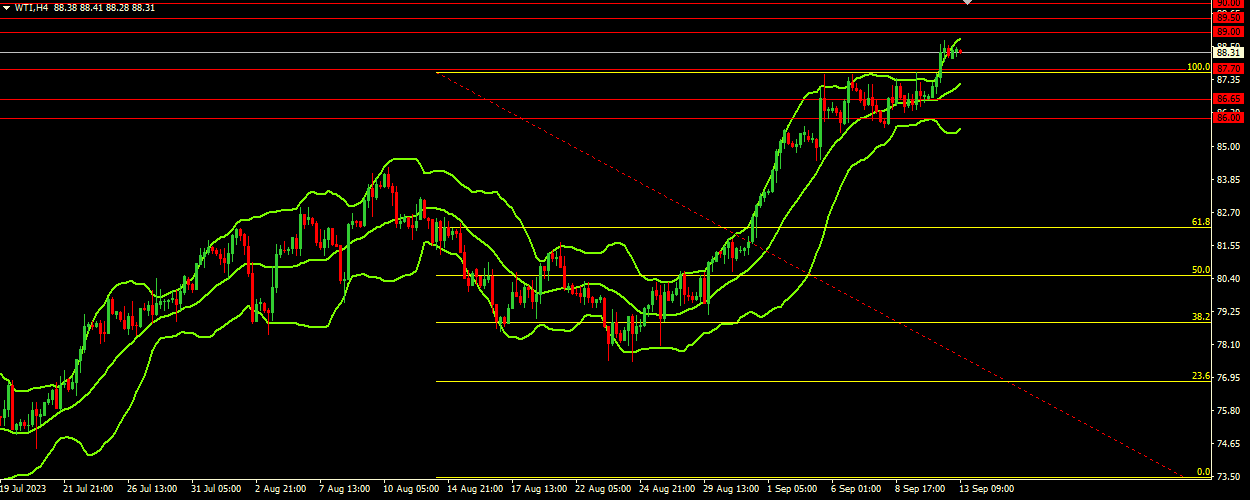
The current WTI price is at 88.30, which brings it close to the first resistance level at 89.00. The next resistance levels are at 89.50 and 90.00, and bullish momentum seems to be pushing the price closer to these points. The Bollinger Bands indicate that the current momentum is bullish. Price is moving close to the upper band located at 88.75, indicating that this level could be touched or broken soon. Given the widening of the bands, volatility is on the rise, which could mean larger price swings in the near future. The middle band, which is a simple moving average, is at 87.20, indicating that the medium-term trend is bullish.
Main scenario (BUY)
Recommended entry level: 89.00.
Take Profit: 89.50.
Stop-loss: 88.70.
Alternative scenario (SELL)
Recommended entry level: 87.70.
Take Profit: 86.65.
Stop loss: 88.50.