
Dollar Index Surges for Three Consecutive Weeks
Introduction:
The Dollar Index has witnessed a robust upward trend over the past three weeks, indicating the strengthening of the US dollar.
Expectations of Prolonged High-Interest Rates:
The dollar's recent gains can be attributed to market expectations that the Federal Reserve will maintain its key interest rates at historically high levels for an extended period. Despite a relative decline in inflation, the Fed's commitment to not lowering rates has bolstered the dollar's appeal.
Positive Economic Data:
The release of favorable economic data in the United States has also supported the dollar's upward momentum. The US Department of Commerce revised its estimate of the country's first-quarter economic growth to 1.3%, surpassing analysts' expectations. This positive data reinforced confidence in the US economy and contributed to the dollar's strengthening.
Ongoing Debt Limit Negotiations:
Investor attention has been focused on the negotiations between Republicans and Democrats regarding the US debt limit. Although an agreement had not been reached by the end of May, the market remained hopeful that a deal would be reached before the deadline. However, rating agency Fitch placed the long-term sovereign rating of the US on review with the possibility of a downgrade due to the prolonged negotiations, which increased the risk of potential missed debt payments.
Federal Reserve's Monetary Policy Outlook:
Minutes from the latest Federal Reserve meeting revealed that while most committee members agreed that inflation remained unacceptably high, some members expressed diminishing confidence in the need for further rate hikes. The timing of future rate increases will depend on inflation data and the tightening of credit conditions in the banking sector.
Hawkish Rhetoric and Dollar Strength:
Remarks from Federal Reserve officials with a hawkish stance, such as St. Louis Fed President James Bullard, who advocated for two more rate hikes this year, have contributed to the dollar's strength. Conversely, Minneapolis Fed President Neel Kashkari highlighted the balanced probability of rate hikes or maintaining the current level at the upcoming Fed meeting in June. The hawkish rhetoric from influential figures, including JPMorgan CEO Jamie Dimon, has instilled confidence in the market regarding sustained higher interest rates.
Conclusion:
The Dollar Index has experienced significant growth for three consecutive weeks, driven by expectations of prolonged high-interest rates, positive economic data, and ongoing debt limit negotiations. The hawkish rhetoric of Federal Reserve officials has further bolstered the dollar's position. However, the ultimate trajectory of the dollar will be influenced by economic indicators, including inflation data and the employment situation. Market participants should closely monitor upcoming key economic releases to gauge the future direction of the US dollar.
Next week's calendar of key events:
May 29
Day off - USA, UK, Switzerland
May 30
5:00 p.m. - U.S.: CB Consumer Confidence Index, May;
May 31
04:30 - China: National Bureau of Statistics' Manufacturing Activity Index, May;
04:30 - China: Non-Manufacturing Business Activity released by the National Bureau of Statistics in May;
10:55 - Germany: Unemployment Rate, May;
3:00 p.m. - Germany: inflation, May (advance);
15:00 - EU: ECB President Lagarde to Speak
June 1
04:30 - Australia: Retail Sales;
10:55 - Germany: HCOB Manufacturing Activity Index (final), May
11:00 a.m. - Eurozone: HCOB Manufacturing Activity Index (final), May;
12:00 - Eurozone: inflation (advance), May;
12:00 - Eurozone: unemployment rate, April;
14:30 - Eurozone: publication of ECB meeting minutes;
15:15 - U.S.: ADP Employment Change, May;
15:30 - U.S.: initial jobless claims, week;
16:45 - U.S.: S&P Global Manufacturing Index (final), May;
5:00 p.m. - U.S.: ISM Manufacturing Index, May;
6:00 p.m. - U.S.: gasoline, crude oil and distillate inventories from EIA, week;
June 2
3:30 p.m. - U.S.: unemployment rate, May;
3:30 p.m. - U.S.: nonfarm payrolls, May;
* GMT+3 time
For more information on important macroeconomic data, see the Investizo calendar.
Euro Weakens Amidst Market Uncertainty: Technical and Fundamental Analysis
Introduction:
The recent performance of the EUR/USD currency pair has shown a decline, with the euro consistently weakening against the US dollar for three consecutive weeks.
Technical Analysis:
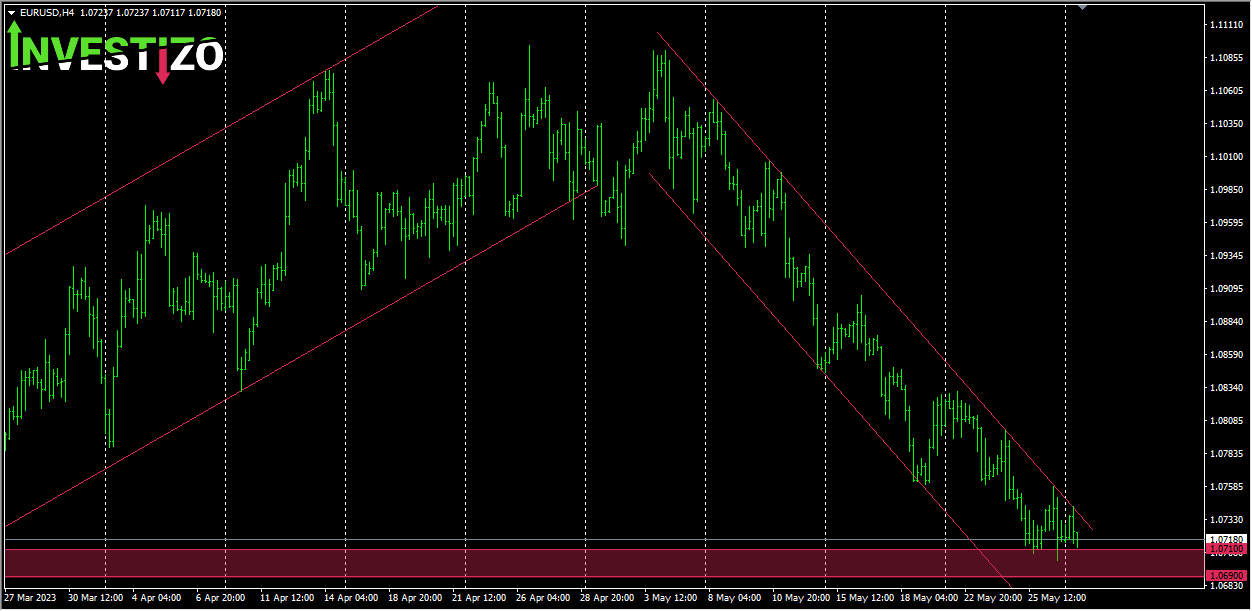
Over the past week, the EUR/USD pair declined 0.79% compared to a 0.46% decline in the previous week. After the reversal at the level of 1.11, the currency pair continues to move within the medium-term descending channel. At the same time now the price increases the upward pressure on the upper border of the price channel, which may lead to its breakdown and the formation of medium-term reversal formations.
If the news events do not strengthen the euro's position, the medium-term target for the EUR/USD pair might be in the range of 1.055 to 1.06.
Fundamental Analysis:
In terms of fundamental analysis, the euro depreciated by 1.02% against the US dollar during the past week, following a 0.46% decline in the preceding week. The euro has been correcting against the dollar for three consecutive weeks due to market participants once again focusing on the Federal Reserve's firm stance on interest rates.
The European Central Bank (ECB) increased its balance by 1 billion euros to 7.73 trillion euros last week, compared to a growth of 12 billion euros in the previous week. The balance has decreased by 1.106 trillion euros from its peak value of 8.836 trillion euros. In the previous week, the ECB expanded its portfolio of bonds from peripheral European countries.
The rhetoric of ECB officials has been relatively moderate. For instance, the Governor of the Bank of Spain, Pablo Hernandez de Cos, believes that the rate hike cycle is approaching its end but has not concluded yet. Similar views are held by ECB Vice President Luis de Guindos. However, François Villeroy de Galhau, a member of the ECB's Governing Council and the head of the French Central Bank, believes that the possible peak of interest rate hikes could occur this summer.
Negative statistical data published last week also contributed to the weakening of the European currency. Germany's GDP declined by 0.3% quarter-on-quarter in the first quarter, despite initial reports indicating no change in the size of the economy. This is the second consecutive quarterly decline, suggesting a technical recession in Europe's largest economy.
Furthermore, the use of the euro as an international payment instrument has reached a three-year low. While the euro continues to lose ground, it remains the second most important currency globally, with a 32% share of international transactions, while the US dollar retains a 43% share.
Conclusion:
Despite the fact that the European currency remains vulnerable, amid the strong dollar and the negative statistics from the EU, the EUR/USD pair may recover some of the previously lost ground in the near future. The market has already won back the negative factors. In the absence of new negative news for the European currency, the EUR/USD pair may show positive movement dynamics.
The pound stabilized above 1.23: Technical and Fundamental Analysis
Technical Analysis:
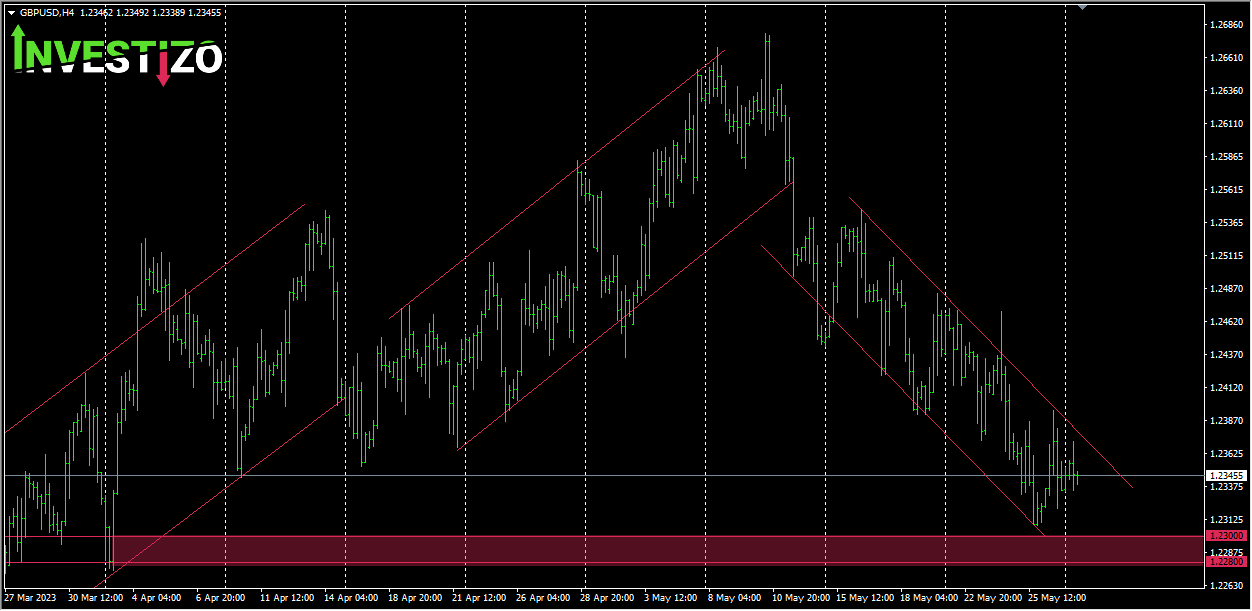
On the chart, the currency pair continues to move within the descending price channel. The range 1.2280-1.2300 can be identified as a key support area. Positive price reaction on these levels and breakdown of the upper boundary of the descending price channel will be good reversal signals.
Fundamental Analysis:
Over the past seven days, the British pound has weakened by 0.73%, hovering around the level of $1.2349 per pound. The focus of investors has shifted towards the US dollar due to ongoing negotiations regarding the US debt ceiling. Additionally, positive employment data from the US has reinforced expectations of sustained higher interest rates in the country. In the UK, recent inflation data revealed persistent inflationary pressures, further strengthening the arguments for another interest rate hike by the Bank of England. While the annual inflation rate decreased to 8.7%, the lowest level in over a year, it still exceeded market expectations of 8.2%. Notably, the core inflation rate, excluding food and energy prices, rose to 6.8%, reaching the highest level in 31 years. Food inflation remained near a 45-year high at 19%.
Meanwhile, retail sales volume in the UK rebounded in April 2023, increasing by 0.5% compared to the previous month. This recovery follows a decline of 1.2% in March and surpasses market expectations of a 0.3% growth. Non-food sales demonstrated notable improvement, rising by 1.0% after a significant decline of 1.8% in March, primarily attributed to adverse weather conditions. Similarly, sales in the food sector increased by 0.7%, recovering from an 0.8% decline in the previous month. However, fuel sales contracted by 2.2% despite lower fuel prices. Over the three-month period ending in April 2023, retail trade grew by 0.8%, the highest reading since August 2021.
In addition to the aforementioned data, preliminary May figures for manufacturing and services purchasing managers' indexes (PMIs) were released by S&P Global/CIPS. The manufacturing PMI stood at 46.9, while the services PMI reached 55.1, both slightly lower than the previous month's figures of 47.8 and 55.9, respectively, and falling slightly below market expectations.
Looking ahead, it is essential to pay attention to the final manufacturing PMI data for May from S&P Global/CIPS, as well as the figures on approved mortgages and consumer credit for April, which may provide further insights into the health of the UK economy.
Conclusion:
The GBP/USD pair currently faces a mixed outlook, with technical indicators suggesting potential short-term stability while fundamental challenges persist. Ongoing negotiations surrounding the US debt ceiling and rising inflation in the UK continue to influence market sentiment. Traders and investors should closely monitor the upcoming macroeconomic data releases and keep an eye on any developments in the US debt ceiling discussions, as they are likely to impact the dynamics of the GBP/USD pair in the near future.