
Fundamental analysis of USD/CAD
The USD/CAD pair found support at the crucial 1.31350 level during the European session, helped by the recovery of the US Dollar Index (DXY) after a rally.
S&P 500 futures showed some volatility after a slight rise in the London session, but the market is calm ahead of the data announcement. However, overall market sentiment remains very optimistic. The DXY is poised for some volatility as inflation data is the main driver of interest rate expectations. Core inflation is expected to moderate as higher gas prices will be offset by lower utility costs. Sustained core inflation could be the result of wage pressures due to labor shortages. While market participants expect only one rate hike from the Fed this year, policymakers are hinting at the possibility of two more inflation-driven rate hikes.
A dynamic labor market is a leading factor. Ahead of the Bank of Canada (BoC) interest rate decision, the Canadian dollar is expected to experience sharp volatility. Last month, the Reserve Bank of Canada raised rates by 25 basis points after stabilizing following January's rate hike. Observers expect a further 25 basis point rate hike due to the tight labor market and above-target inflation. Notably, oil prices are meeting resistance around the 75.00 level. Canada's position as the largest oil exporter to the U.S. means that rising oil prices tend to support the Canadian dollar.
Ahead of two important events: the release of US inflation data and the Bank of Canada's interest rate decision, the USD/CAD exchange rate fell to lows not seen since late June. Investors are closely watching these events, especially the US inflation data, which is expected to show a 5% rise in core consumer prices for June, which could reveal information about the Fed's ongoing fight with inflation. The weakness of the US inflation report is already reflected in current market prices, but there is always the risk of a "buy the rumors, sell the facts" reaction if the data doesn't change. Expectations will be justified. In addition, the downward trend in US Treasury yields further weakened the US Dollar, while the expected rate hike by the Bank of Canada supported the US Dollar.
Another rate hike by the Bank of Canada is expected despite high borrowing costs due to Canada's strong economic growth and tight labor market. The overnight lending rate is expected to be raised by 25 basis points to 5%. As a result, the USD/CAD pair fell to two-week lows ahead of this important economic event. While the US Dollar continues to be impacted by Fed policy tightening, the Bank of Canada is expected to raise rates amid concerns over business activity growth and inflation. These events will be the focus of traders and investors going forward.
Technical Analysis and Scenarios:
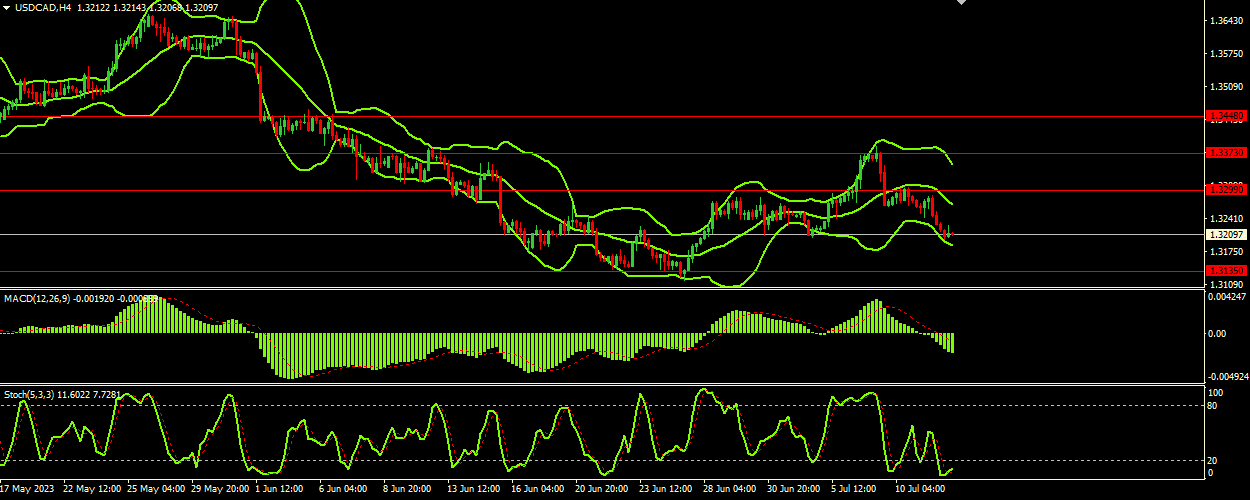
The Stochastic Oscillator value of 11.4747 below the 20 level indicates an oversold market, which could potentially lead to a rebound in prices. However, the bearish signal at 7.6856 indicates further selling pressure.
The Bollinger Bands indicate a downtrend and price is currently in the lower band range at 1.32090, below the middle band at 1.32680. This indicates the presence of a downtrend. The narrowing of the price band may indicate a decrease in volatility, suggesting a continuation of the trend.
MACD, whose value (-0.001922) is below the signal line (-0.000859), also indicates a bearish trend, which reinforces the sell scenario.
Main scenario (SELL)
Recommended entry level: 1.31350.
Take Profit: 1.30800.
Stop Loss: 1.31500.
Alternative scenario (BUY)
Recommended entry level: 1.32990.
Take Profit: 1.33730.
Stop loss: 1.32500.