
Fundamental analysis of GBP/USD
The GBP/USD currency pair continues to decline for two consecutive days and is trading at 1.28040.
The GBP/USD pair showed signs of recovery at the end of the week, helped by a weaker-than-expected US PCE Core Price Index.
The UK economic backdrop starts the week in a subdued manner, drawing attention to the housing statistics for June, including loan and mortgage approval data, which will influence the GBP/USD pair's minor movement. The focus is on the Bank of England's consumer credit report, which is expected to show an increase in consumer credit in June from GBP 1.144 billion to GBP 1.3 trillion.
However, Bank of England Governor Bailey emphasized the importance of managing inflation. Following Deputy Governor Dave Ramsden's comments on persistently high inflation, economists surveyed last week unanimously said interest rates would rise from 5% to 5.25%, with the maximum possible after a round of rises at 5.75%. More importantly, the Bank of England's surprise rate hike of 50 basis points to 5.00% has raised concerns about the biggest rate hike in 30 years and its impact on the economy. The UK economy is under severe pressure and the real estate sector is showing signs of slowing down due to higher borrowing costs. These higher costs are also affecting retail orders and manufacturing operations. Last week's data showed that economic activity in the UK was weaker than expected, with the index of business activity in the manufacturing sector falling to 45.0 in July from 46.5 in June, and the preliminary index of business activity in the services sector falling to 51.5. from 53.0 previously.
In the US, the focus was on Chicago PMI data for July. Unless the index falls below 40, investors should ignore the July data, looking ahead to Tuesday's release of the ISM manufacturing PMI. After the Core PCE price index weakened, investors are looking for clues that the Federal Reserve will raise interest rates in September. The employment and price components of the PMIs will play an important role in shaping investor sentiment. The Core PCE price index, the preferred measure of inflation used by the U.S. Federal Reserve, fell to 3% in June from 3.8% in May, below market expectations of 3.1%. Encouraging signs of US GDP growth in the second quarter, rising durable goods production and a still tight labor market may prompt the Federal Reserve to raise interest rates further.
In the near term, market participants will be keeping a close eye on the Bank of England's rate decision on Thursday. The upcoming speech by Bank of England Governor Andrew Bailey may provide additional information on the monetary policy stance towards the GBP/USD pair. On the other side of the Atlantic, the Non-Farm Payrolls figure remains a concern in the US, where 180,000 new jobs are expected and the unemployment rate remains unchanged at 3.6%.
Technical analysis and scenarios:
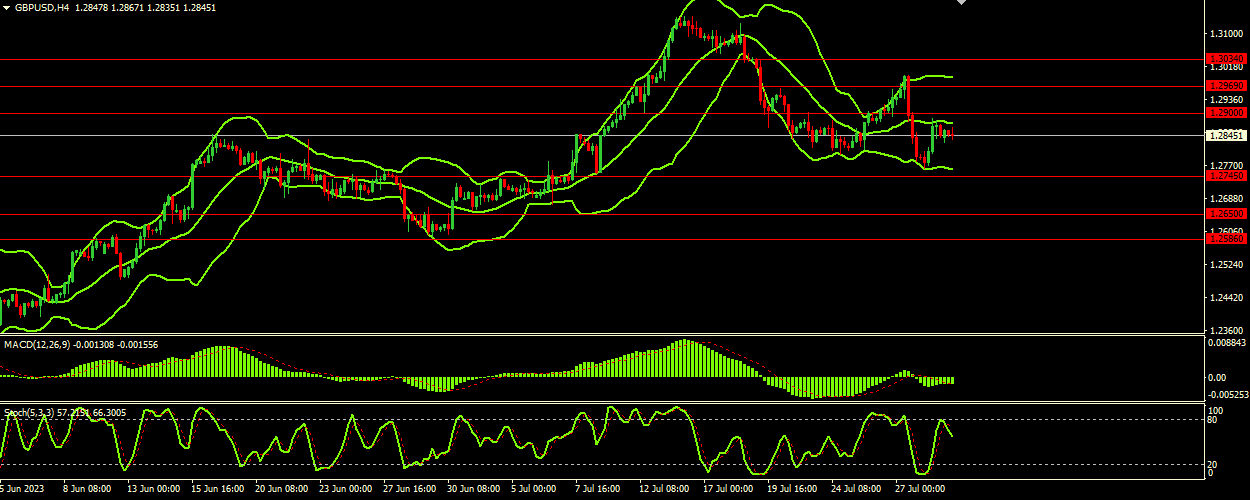
The GBP/USD pair is currently trading at 1.28380. Looking at the support and resistance levels, the major levels to watch are 1.30340, 1.29690, 1.29000 for resistance and 1.27450, 1.26500, 1.25860 for support. The Stochastic oscillator (5,3,3) shows a value of 54.4924, which does not indicate overbought or oversold. However, the downward bias from the previous signal at 65.3929 indicates a possible slowdown in buying pressure. The Bollinger Bands are showing a horizontal direction with the upper band at 1.29900, middle band at 1.28780 and lower band at 1.27590. Currently, the price is moving in the lower band indicating a potential bearish bias. A widening price range could indicate an increase in price volatility. Finally, the MACD (12,26,9) is near the zero line with a value of -0.001364 and a signal of -0.001562, indicating a somewhat balanced market that does not yet have a clear trend direction.
Main scenario (SELL)
Recommended entry level: 1.27450.
Take Profit: 1.26500.
Stop Loss: 1.27950.
Alternative scenario (BUY)
Recommended entry level: 1.29000.
Take Profit: 1.29690.
Stop loss: 1.28750.