
Fundamental analysis of XAU/USD
The XAU/USD pair saw a slight pullback on Tuesday and is trading at 1955.50. The decline was caused by the strengthening of the US dollar as investors' attention was focused on upcoming economic data.
The XAU/USD price is in a volatile position due to the strengthening US dollar and concerns about China. The US Dollar Index (DXY) hit a three-week high amid rising Treasury yields despite mixed US business activity data the previous day. The recent uptrend and rise in the dollar index may be linked to concerns about an escalation in the US-China conflict following Beijing's recent decision to restrict drone exports, citing "national security" measures to counter US technology and commercial warfare tactics and hawkish statements from US economists. Notably, China's July business activity index for the manufacturing sector fell to 49.2 from 50.5, contrary to market forecasts of 50.3. This drop is the largest since January, which affected gold prices as China is a major consumer of XAU/USD.
July's rise in gold prices was the highest monthly gain in four months. This rise was driven by predictions that global central banks may soon end their series of rate hikes. However, the current uptrend is running into technical resistance. Recent statements by Jerome Powell have served as a wake-up call, indicating that the market may have overreacted to some disappointing US economic data. The Chicago Fed said the central bank is carefully adjusting its actions to fight inflation without triggering a recession. That approach is heavily data-dependent, and September will be a crucial month to determine whether monetary policy needs to be tightened further.
Central banks around the world are keeping a close eye on the inflationary scenario, hoping for a period of deflation soon. Their cautious approach is due to their focus on data-driven decisions. In the next few days, US employment statistics will play a key role in shaping expectations for a possible change in Fed interest rates. Any positive anomaly in the employment data could hint at further rate hikes, which would put downward pressure on gold prices.
The resilience of the U.S. dollar is also a factor in gold's decline. A recent survey by the US Federal Reserve showed that US banks have tightened credit standards, as well as a decline in business and consumer loan applications in the second quarter. Thus, the gold price may be volatile in the short term, influenced by economic data and statements from central bankers. To fully understand the outlook for the gold price, investors need to keep a close eye on the Federal Reserve's inventory and employment data.
On the other hand, China's National Development and Reform Commission released a statement that encourages high-quality private investment, providing security for XAU/USD prices. In addition, China announced measures to stimulate consumption, which has a positive impact on market sentiment.
Overall, downward pressure on gold is being exerted by market expectations of the ISM US manufacturing PMI for July as well as the June jobs data. In conclusion, gold prices may experience short-term fluctuations based on economic data and statements from central bank officials. Investors should keep a close eye on employment figures and Fed actions to better gauge the outlook for gold prices in the near term.
Technical Analysis and Scenarios:
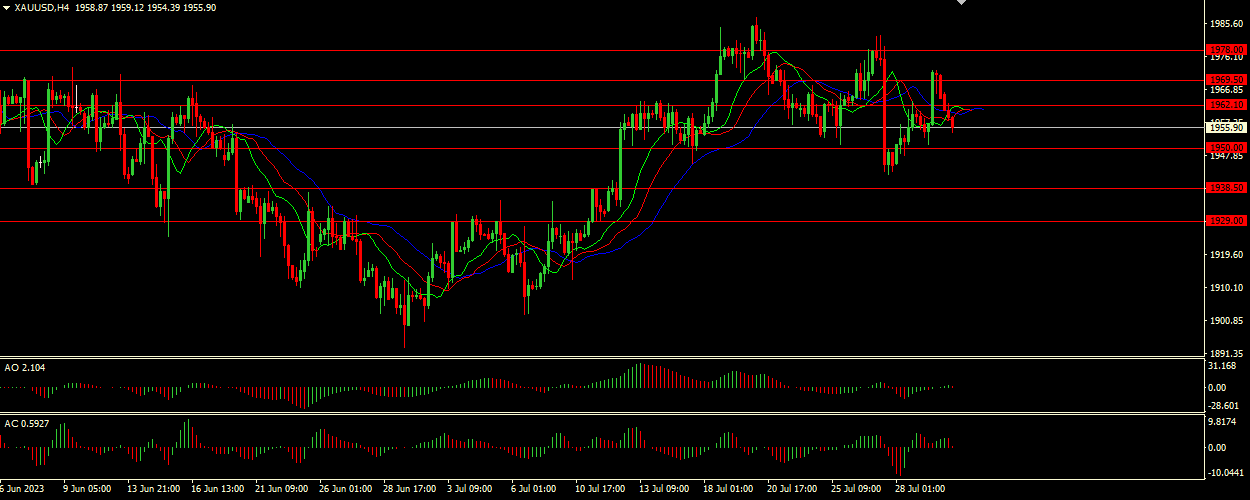
The current gold price (XAU/USD) is at 1955.50, the market appears to be in a consolidation phase as evidenced by the Alligator indicator. It shows that the moving averages are intertwined with each other, indicating a flat market without a definite trend. The Awesome Oscillator (AO) and Accelerator Oscillator (AC) are in the red zone near the zero level, indicating strong selling pressure.
Main Scenario (SELL)
Recommended entry level: 1950.00.
Take Profit: 1938.00.
Stop loss: 1955.00.
Alternative scenario (BUY)
Recommended entry level: 1962.10.
Take Profit: 1969.50.
Stop loss: 1955.00.