
Fundamental analysis of WTI
Oil prices declined at the beginning of the week, bouncing back from seven-week highs, mainly due to a weak economic recovery in China and a stronger US dollar. WTI crude oil prices are currently hovering around 81.90.
China, the world's largest oil consumer, is facing challenges in regaining economic stability after the pandemic. The latest data shows a deflationary trend, with the full-year consumer price index declining 0.3% in July versus 0% previously. This deflationary situation, coupled with a rising US dollar, is putting downward pressure on global oil demand, particularly impacting those trading in alternative currencies. In addition, relations between the U.S. and China have been very strained of late. The U.S. administration, led by President Joe Biden, has issued a directive restricting new U.S. investment in certain Chinese technology sectors, such as quantum computing and artificial intelligence. The move has raised concerns about possible retaliation from Beijing, especially in the area of technology trade.
However, against these negatives, OPEC, backed by major players such as Saudi Arabia and Russia, offers an optimistic outlook. Recent reports from OPEC and the International Energy Agency indicate a positive outlook for oil demand in the second half of the year, supported by factors such as summer tourism, increased use of oil for power generation and rising petrochemical production in China. According to OPEC's latest forecast, global oil demand will increase by 2.44 million bpd in 2023, while the IEA predicts an increase of 2.2 million bpd. OPEC also revised its global economic growth forecast to 2.7% this year and 2.6% next year, pointing to strong growth in countries such as the U.S., Brazil. and Russia. Supply constraints, particularly voluntary cuts by Saudi Arabia, which announced an extension of voluntary cuts of 1 million bpd through September, are exacerbating the coming export decline. Russian oil exports also fell by 300k bpd in September, supporting the possibility of an oil price recovery. This reinforces the view that OPEC+ is seeking to offset a possible drop in demand.
In the coming days, traders will keep an eye on US retail sales data and comments from the Federal Open Market Committee (FOMC) meeting participants. In addition, data such as the American Petroleum Institute's weekly crude oil inventory report and the EIA's crude oil inventories report will play an important role in determining the price dynamics of WTI crude oil. Thus, while factors such as China's economic concerns and a strong US dollar provide a bearish backdrop, OPEC's strategic interventions and other market dynamics provide a potential bullish counterbalance. However, unforeseen geopolitical complications could lead to market volatility. The short-term outlook suggests cautious market sentiment with a slight bias, pending clearer clues from the economic and geopolitical situation.
Technical analysis and scenarios:
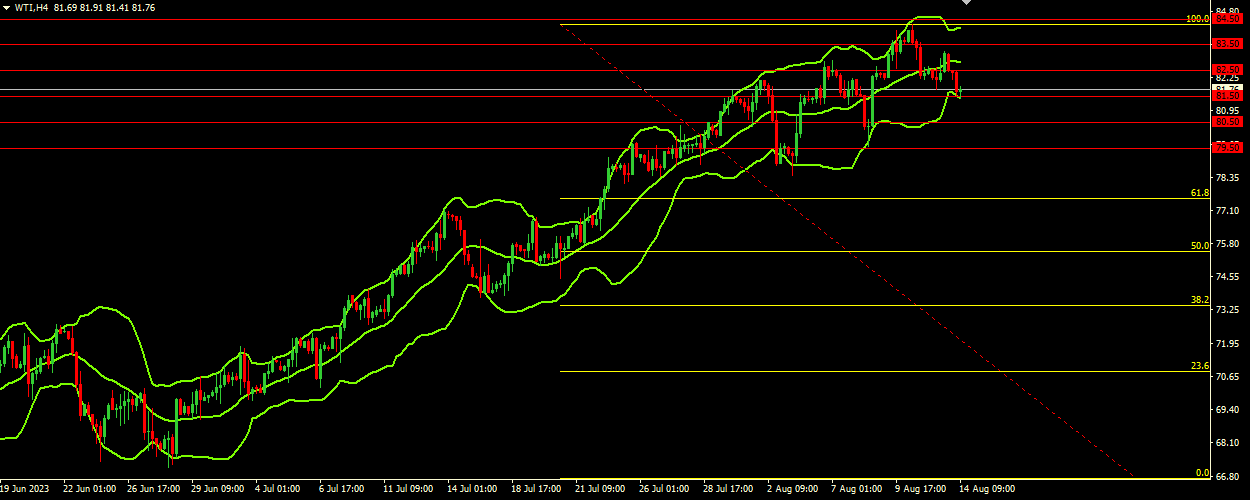
WTI crude oil is currently trading at $81.90, caught between significant support and resistance levels. Immediate support is at $81.50, which is quite close to the lower boundary of the Bollinger Bands at $81.45. Given that the price is in the lower Bollinger Bands range while the indicator has an upward trajectory, this may suggest that the current price is undervalued and may try to return to the middle level represented by the middle band at $82.80. Resistance levels are in close proximity at $82.50, $83.50 and $84.50. The upper Bollinger Band is located at $84.20, indicating potential resistance near this level. In conclusion, although the main scenario looks bullish given the current price position within the Bollinger Bands, traders should remain vigilant for signs of a reversal or continuation of the downtrend.
Main scenario (BUY)
Recommended entry level: 82.50.
Take Profit: 83.50.
Stop Loss: 82.00.
Alternative scenario (SELL)
Recommended entry level: 81.50.
Take Profit: 80.50.
Stop loss: 82.00.