
Fundamental analysis of EUR/USD
The EUR/USD currency pair is recovering from Friday's decline, trading at 1.08880.
Markets started the week with low EUR/USD volatility, although all eyes were on July producer prices in Germany, which could determine the direction of the pair's movement. Continued weak demand is putting pressure on producers and stiff competition is forcing them to cut prices. While lower prices ease inflation concerns, they also signal problems in the economy and increase the risk of a prolonged recession, which could prompt the European Central Bank to maintain its current stance. In particular, a fall in German producer prices above the expected 5.1% annualized rate could have a negative impact on EUR/USD. The words of ECB officials are significant as inflation remains a major concern for central banks. ECB Chief Economist Philip Lane recently expressed confidence in the Eurozone's ability to avoid a prolonged recession. Upcoming private sector PMI data will be important to confirm signs of economic recovery.
In the US, any comments from the Fed will be closely watched following strong economic data. Market sentiment towards the Fed's monetary policy remains generally hawkish. However, "dovish" rhetoric could leave the dollar vulnerable. In addition, global market sentiment and risk perceptions also influence the direction of currency pairs, with uncertainty increasing the dollar's appeal as a safe-haven asset. Other major indices outside the eurozone showed mixed economic conditions.
The Chinese government's economic strategy is being closely watched, emphasizing the need for substantial stimulus measures to ease concerns about the stability of the Chinese economy and the risk of its collapse, after the People's Bank of China decided to cut the one-year lending rate by 10 basis points to revive the economy. If these measures fail to boost confidence, EUR/USD could face further downward pressure in the near term. Eurozone and US PMI data have attracted investors' attention and we expect possible shifts in sentiment regarding the Fed's stance to cause volatility in the market and affect EUR/USD.
Technical analysis and scenarios:
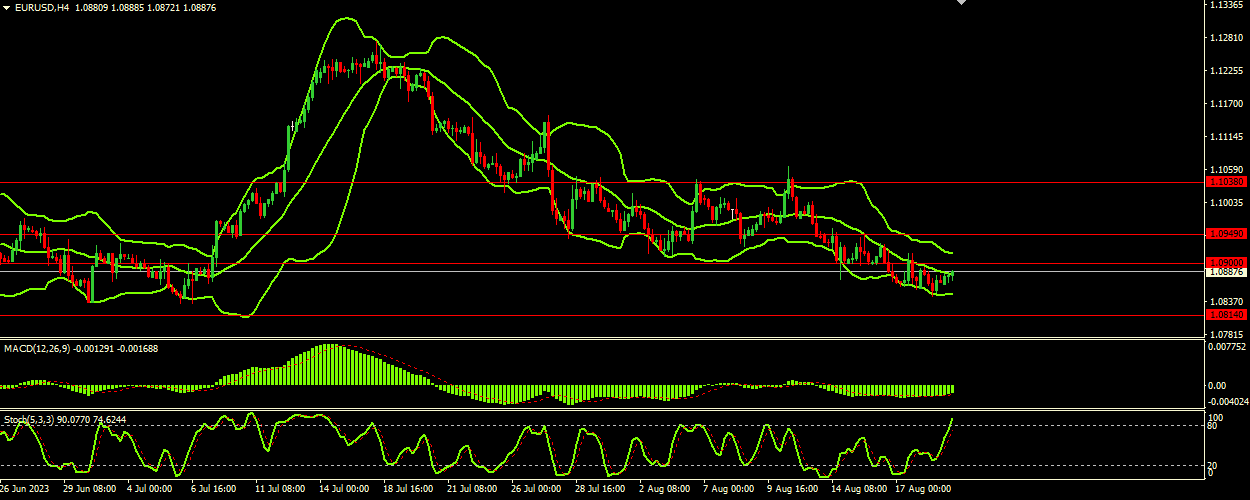
The Stochastic oscillator is in overbought territory with a value above 80, indicating that the pair may be overextended to the upside. A value above the signal indicates bullish momentum. Currently, the price is trading near the middle band, indicating neutrality. The narrowing of the Bollinger Bands indicates a decrease in volatility, hinting at the possibility of a significant move in the near future. The direction of the indicator is downward, indicating a potential bearish bias. The MACD line is slightly above the signal line, indicating a potential bullish crossover. However, both values are quite close to the zero line, indicating that there is no strong impulse in one direction or the other. Given the overbought Stochastics, as well as the narrowing of the Bollinger Bands, indicating potential coming volatility, a pullback may occur in EUR/USD.
Main scenario (SELL)
Recommended entry level: 1.08140.
Take Profit: 1.07260.
Stop Loss: 1.08450.
Alternative scenario (BUY)
Recommended entry level: 1.09000.
Take Profit: 1.09490.
Stop loss: 1.08800.