
GBPUSD H1: The Chaos Theory Forecast for the Asian Session on 27.12.2024
Technical
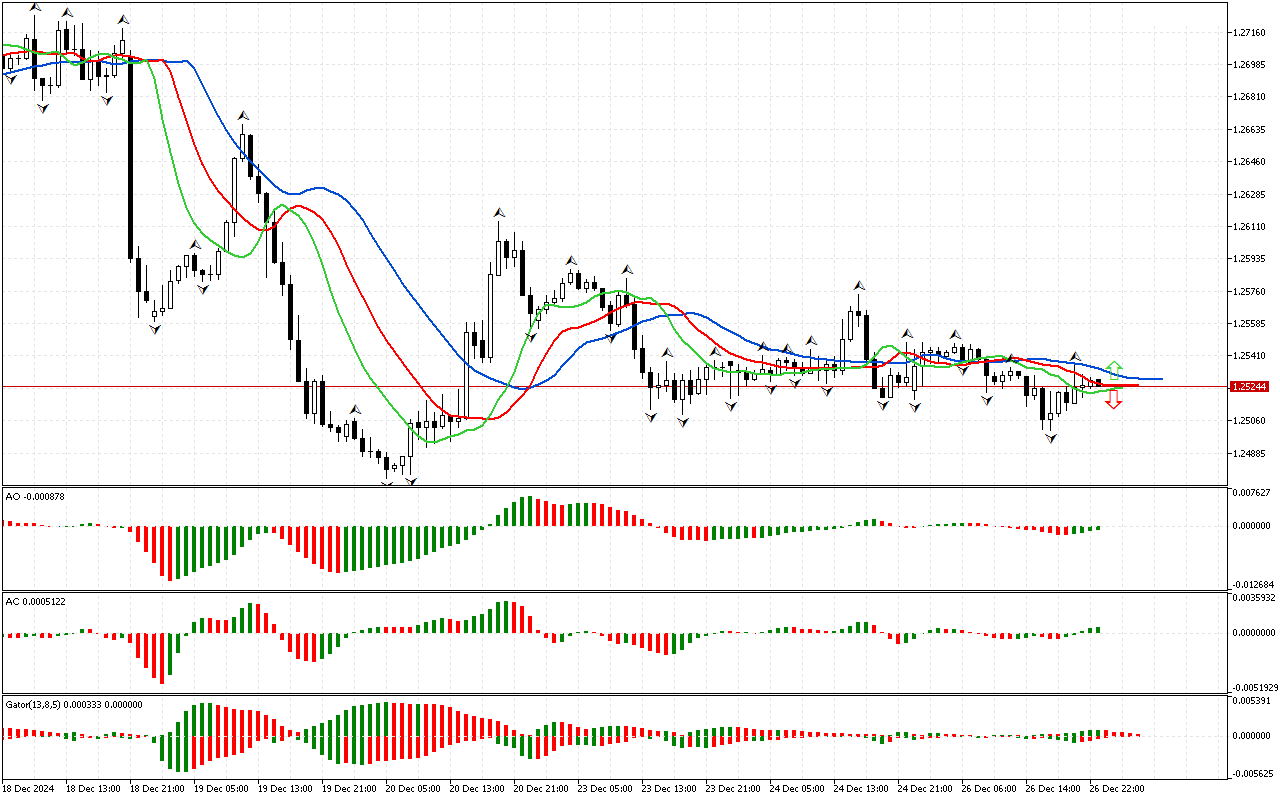
The analysis of the GBPUSD graph shows that the phase space is undefined. The price is between two fractals that can be used to determine the state of the market....
The analysis of the GBPUSD graph shows that the phase space is undefined. The price is between two fractals that can be used to determine the state of the market. According to Bill Williams' Chaos Theory, attention should be paid only to fractals that are outside the Alligator's mouth boundaries. Therefore, to determine the further prevalent direction of price movement, it is worth waiting for the price to cross the fractal.
The alligator remains active, indicating a possible continuation of movement in the market.
At the same time, the AO indicator remains in the negative zone.
The color of the histograms of the Gator indicator changes, so this indicator has not formed a clear signal yet.
Several red columns have been formed on the Gator indicator. This is a signal that may indicate the development of a corrective movement in the near future.
Let's summarize. The phase space is not defined. Therefore, it is worth ignoring the signals of other indicators for now and waiting for the breakdown of one of the fractals. This is a predictive event that will help determine the market phase and the priority direction of price movement.
📊 Buy Stop 1.25359
❌ Stop Loss 1.25355
✔️ Sell Stop 1.25006
❌ Stop Loss 1.25324
After entering the market, Stop Loss is moved along the red line after the closing of each candle. The profit is fixed by moving Stop Loss, or when impulse weakening signals appear on the AO, AC, Gator indicators.
The alligator remains active, indicating a possible continuation of movement in the market.
At the same time, the AO indicator remains in the negative zone.
The color of the histograms of the Gator indicator changes, so this indicator has not formed a clear signal yet.
Several red columns have been formed on the Gator indicator. This is a signal that may indicate the development of a corrective movement in the near future.
Let's summarize. The phase space is not defined. Therefore, it is worth ignoring the signals of other indicators for now and waiting for the breakdown of one of the fractals. This is a predictive event that will help determine the market phase and the priority direction of price movement.
📊 Buy Stop 1.25359
❌ Stop Loss 1.25355
✔️ Sell Stop 1.25006
❌ Stop Loss 1.25324
After entering the market, Stop Loss is moved along the red line after the closing of each candle. The profit is fixed by moving Stop Loss, or when impulse weakening signals appear on the AO, AC, Gator indicators.

Author
Nikolai Krishtopov
Market Analyst & Marketing Manager, Investizo
Nikolai Krishtopov is a Market Analyst at Investizo with more than 15 years of experience in the financial markets industry and over a decade of trading experience. His areas of focus include forex and crypto markets, technical analysis, intraday trading and market behaviour.