
The dollar index has gained more than 2% in two weeks. Can the dollar continue to rise?
The dollar index (DXY) continues to show growth, having risen by more than 2% over the past two weeks. Such growth is due to a number of factors that contribute to the strengthening of the U.S. currency in world markets. Throughout April, the dollar index was in consolidation near the annual lows, but in May it began to show signs of an upward reversal. Last week the DXY index closed near 103 points, which is the highest level since mid-March.
Positive signals on the U.S. economy and comments from Federal Reserve (Fed) officials last week sent the DXY Index soaring for two weeks in a row. The general consensus among Fed officials was that U.S. inflation was still high, which would likely lead to further rate hikes.
Despite the Fed's hawkish statements, the market generally expects a pause in the interest rate hike cycle. However, given the likelihood that U.S. interest rates will remain at high levels for an extended period of time, emerging market currencies may remain under pressure.
Last week, the US currency was also positively influenced by the announcement by President Joe Biden and the top Republican in the US Congress, Kevin McCarthy, of his intention to conclude an agreement to raise the US government debt ceiling to $31.4 trillion in the near future. This announcement supported the demand for the dollar.
In addition, Treasury bond yields continue to rise. After comments of FRS officials, the market started to expect the rate increase by 25 basis points at June meeting of the regulator. Earlier the estimate of the probability of such an increase was only 11%, and a month ago a rate cut was even expected.
Last week, the Commodity Futures Trading Commission reported that net short positions of hedge funds and other speculators reached their highest level since mid-2021. Normally, such a strong bias would be supportive of a rising dollar.
However, the U.S. domestic data released last week was not necessarily positive. New York State's manufacturing activity index fell sharply to its lowest level in four months. Industrial production data also fell short of expectations, showing an increase of only 0.5%, down from 0.0% a month earlier. A decline was also seen in secondary real estate sales, which were down 3.4% from the previous month.
Nevertheless, despite some negative statistics, the dollar index continues to rise under the influence of other factors voiced above.
On Monday the dollar was able to hold its ground gained at the end of the previous trading week due to the absence of important geopolitical and economic news.
There will be a number of important economic publications, which can also have a strong effect on the USD in the second half of the week. Strong macro data from the U.S. may push the dollar higher against other currencies. Friday's FOMC meeting report and the Personal Spending and Personal Income index will be the main events of the week.
Next week's calendar of key events:
May 23
16:45 - U.S.: preliminary data on the index of business activity in the manufacturing sector, May;
16:45 - U.S.: preliminary data on services business activity index, May;
17:00 - U.S.: new home sales, April;
23:30 - U.S.: API Crude Oil Inventory Change;
May 24
02:00 - Japan: Japan's major manufacturers' business sentiment index from Tankan, May;
09:00 - UK: inflation data, April;
11:00 - Germany: business climate data from Ifo, May;
11:00 - UK: industrial orders data from CBI, May;
5:30 p.m. - U.S.: gasoline, crude oil and distillate inventories from EIA, week;
21:00 - U.S.: publication of FOMC meeting minutes;
May 25
09:00 - Germany: consumer confidence index from GfK, June;
09:00 - Germany: GDP growth rate (final data), Q1;
11:00 - UK: retail sales data, May;
15:30 - U.S.: initial jobless claims, week;
15:30 - U.S.: Federal Reserve Bank of Chicago National Activity Index, April;
15:30 - U.S.: GDP growth rate (second estimate), Q1;
3:30 p.m. - U.S.: pending real estate transactions, April;
May 26
09:00 - UK: retail sales, May;
3:30 p.m. - U.S.: personal spending and personal income index, April;
15:30 - U.S.: durable goods orders, April;
5:00 p.m. - U.S.: University of Michigan Consumer Expectations, May;
5:00 p.m. - U.S.: University of Michigan Consumer Confidence, May;
* GMT+3 time
For more information on important macroeconomic data, see the Investizo calendar.
EUR/USD
Fundamental analysis
During the last week there was a decline of 0.46% of the euro against the U.S. dollar. This decline came after the previous fall of 1.65% a week earlier.
Last week the European Commission improved the forecasts for 2023 for almost all eurozone countries. This is due to the favorable state of the labor market and the maintenance of low unemployment at 6.1% as well as the normalization of the situation on the EU gas market. Eurozone GDP is expected to grow by 1.1% in 2023, compared to the autumn forecast of 0.3%. In addition, GDP is expected to grow by 1.6% in 2024. However, the growth rate of the region's leading economy, Germany, remains modest. Growth is expected at just 0.2% in 2023, but it is better than the previous forecast of -0.6%.
Germany's statistics released today were mixed. Activity in the German manufacturing sector is contracting while the services sector continues to show strength.
Germany's manufacturing activity index fell to 42.9 points in May, below the expected 45.0. This indicator is an indicator of the overall health of the manufacturing sector and indicates a contraction in this area. It is also worth noting that this level is the lowest in the last 36 months. This indicates an unfavorable situation in the manufacturing sector in Germany.
On the other hand the index of business activity in the service sector in Germany increased to 57.8 points in May against expectations of 55.5 points. This indicates an increase in activity in the service sector and indicates a positive trend in this area of the economy. The indicator reached its highest level in 21 months.
According to the preliminary HCOB report, activity in Germany's manufacturing sector continues to decline while the service sector continues to show strength. This is confirmed by business activity indexes data that indicate negative trends in the German economy.
Recall that index of economic sentiment in Germany, published last week, calculated by ZEW institute, decreased to -10.7 points in May, which shows negative expectations in the German economy. This decrease in the index indicates uncertainty and pessimism among institutional investors.
Currency markets are also reflecting mixed data on the economic situation in Germany. EUR/USD continues to lose ground and is trading below the 1.0800 level. At the moment the pair is down 0.15% to 1.0795. This indicates the weakness of the Euro against the US dollar. Negative data related to the German manufacturing sector may put pressure on the Euro.
Technical analysis
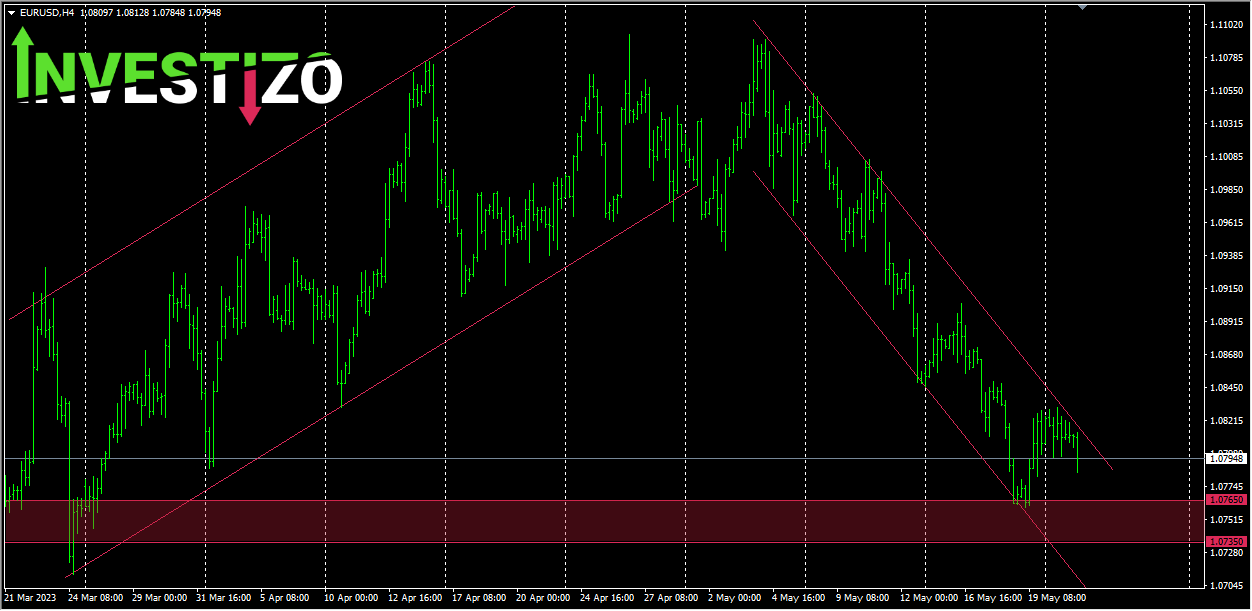
On the four-hour chart of the EUR/USD pair is still dominated by the downtrend. The buyers' attempt to resume growth has been unsuccessful so far. Today the price came out of the micro consolidation downwards. On this background in the short-term the quotes' decline to the upper border of the support area 1.0735-1.0765 may be expected. Reversal signals may be expected in this range, but if the buyers are not able to keep the price above 1.0735, in the midterm the currency pair may continue decreasing towards 1.0550.
GBP/USD
Fundamental analysis
Amid expectations of the speech of the Governor of the Bank of England (BoE) Andrew Bailey, the pair GBP/USD looks vulnerable and declined to the local low, located near the 1.2400 mark. Investors are selling the British currency amid local uncertainty, trying to assess possible signals on interest rates and further monetary policy from the Bank of England.
Local weakness in the US Dollar Index (DXY), which faces resistance above the 103.30 level, may protect the pound from further declines, as its upside potential is limited by a delay in the decision to raise the US government debt ceiling, as well as hawkish comments from Federal Reserve (Fed) members.
The U.S. Dollar Index (DXY) is expected to remain vulnerable before the release of preliminary data from the S&P May Business Activity Index (PMI). The manufacturing PMI is expected to fall to 50.0 from the previous reading of 50.2, while the service sector index is expected to remain stable at 53.6. If the manufacturing PMI stays above 50.0 for the second month in a row, it would signal that the manufacturing sector is out of the contraction phase.
Preliminary data on service sector activity published today showed that the index went down from 55.9 to 55.1 points over the month, compared to the forecast of 55.5. Despite the decline, the index is still comfortably above 50, indicating that activity in a key sector of the UK economy is rising. This could provide support for the British currency in the second half of the trading day.
Technical analysis
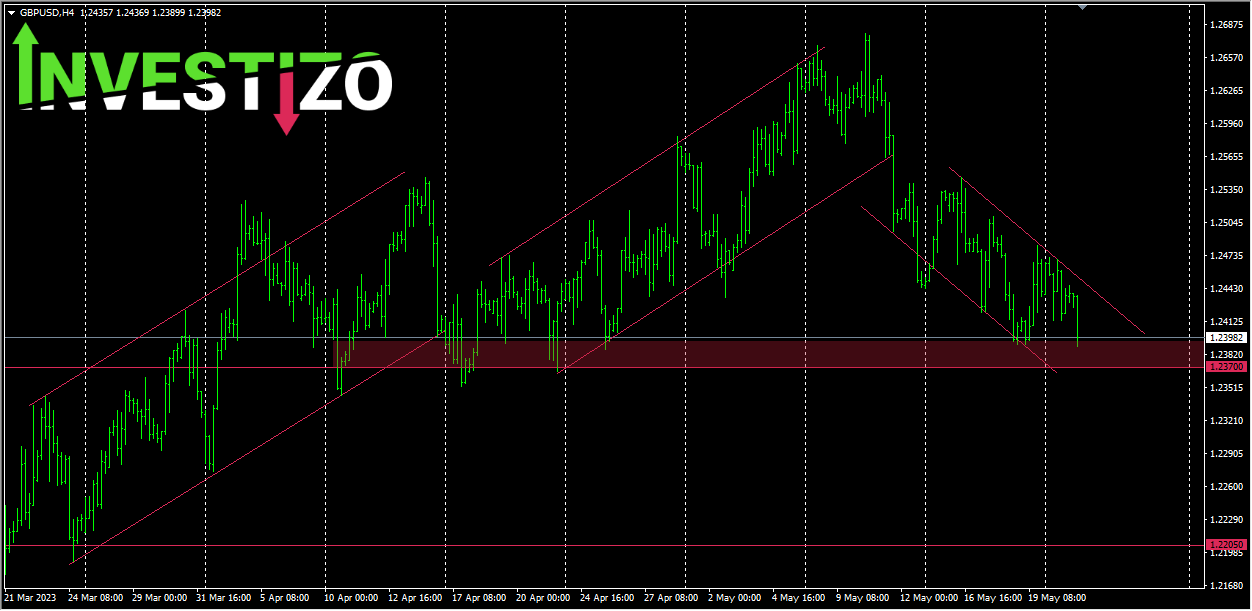
On the four-hour chart the currency pair continues to move within the descending channel. There are no reversal signals on the chart so far, but the price is approaching a fairly strong support area formed around the level of 1.2370. Therefore, medium-term reversal signals may be formed in the range between the levels of 1.2370-1.2400.