
Fundamental analysis of WTI
WTI crude oil prices rose significantly and reached their highest level since April due to a combination of strong demand, tight supply and market sentiment and traded at 81.60.
On the one hand, the United States, the world's largest fuel consumer, has provided a surge in oil prices as strong demand has helped offset demand problems in other regions such as India, Europe and China. The latest data from the American Petroleum Institute showed that crude inventories fell by 15.4 million barrels in the last week of July, the biggest decline in 40 years. This, if confirmed by U.S. government data, reflects strong demand in the U.S., also evidenced by a 1.7 million barrel decline in gasoline inventories and a 510,000 barrel decline in distillate stocks. A seasonal peak in demand for transportation fuels and a reduction in oil supplies to producing countries led by Saudi Arabia played a big role in the rise. OPEC oil production fell by 900,000 bpd last month, the biggest decline in three years. In addition, Saudi Arabia's voluntary 1 million bpd cut in oil production is expected to continue through September, contributing to the uptrend.
Nevertheless, there are challenges to maintaining this upward momentum. Recession in regions such as Europe and the possibility of reduced oil purchases in China could be limiting factors. In addition, peak demand in late summer will limit this uptrend. External factors, such as Fitch's downgrade of the US government's credit rating from AAA to AA+, could have a significant negative impact on US fundamentals and trigger risk aversion. This was reflected in S&P 500 futures, which lost 0.4% on the day, while the yield on 10-year US Treasuries fell from three-week highs. Ambiguous signals in a market where the U.S. Dollar Index (DXY) remains on the defensive are also contributing to a complicated scenario around the price of WTI crude oil.
Despite today's decline, WTI continues to receive support from discussions on energy supply cuts. The key indicators to track the direction of oil prices will be the weekly US Energy Information Administration data on oil inventories and US employment data for July. To summarize, the upward momentum for WTI is being shaped by a combination of strong US demand, significant inventory drawdowns, OPEC production cuts and challenging market dynamics. While oil prices are expected to continue their uptrend, they are unlikely to rise above 90 USD per barrel, with demand challenges persisting in some regions. Traders should closely monitor geopolitical events and changes in supply and demand to navigate current market conditions.
Technical Analysis and Scenarios:
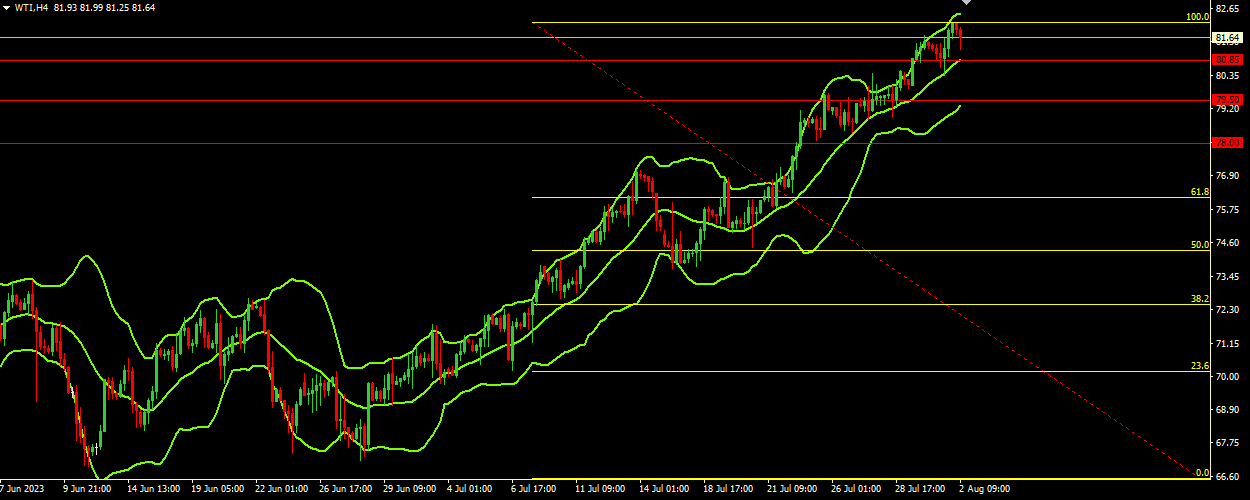
WTI crude oil price is currently trading at 81.60, which is close to the upper Bollinger Bands at 82.50, indicating that the price is in a higher range. The Bollinger Bands are pointing upwards, indicating a potential bullish trend. However, as the price is declining in the lower range of the indicator, a downward correction may be imminent.
Main scenario (BUY)
Recommended entry level: 82.50.
Take Profit: 85.00.
Stop loss: 80.50.
Alternative scenario (SELL)
Recommended entry level: 80.85.
Take Profit: 79.50.
Stop loss: 81.50.