
Fundamental analysis of WTI
Oil prices have fallen recently, exacerbated by troubling economic data and supply concerns in major economies. The market is now nervous and waiting for another speech by US Fed Chairman Powell to better understand the possibility of a rate adjustment.
The main reason for the recent price fluctuations was the disappointing manufacturing data revealed by various purchasing managers' index readings. In particular, Japanese factory activity has been declining for 3 consecutive months since August. In addition, economic activity in the Eurozone declined more than expected. The UK economy is on the brink and may face recession. At the same time, the US is seeing the weakest growth momentum since February.
The poor economic performance of the world's major economies will inevitably raise concerns about oil demand. The symposium at Jackson Hole is attracting attention because it will feature prominent representatives from major central banks such as the Federal Reserve, the European Central Bank, the Bank of England and the Bank of Japan. It is expected that the talks may focus on keeping interest rates high even if inflationary pressures ease.
Supply dynamics also have an impact on developments. Iran's oil production is expected to reach 3.4 million bpd by the end of September, despite ongoing US sanctions. In addition, the US is beginning to prepare proposals to ease sanctions on Venezuela's oil industry. This initiative would allow more companies to import Venezuelan oil, provided that Venezuela holds transparent and fair presidential elections. With WTI crude oil recently reaching resistance at around 84.00, the prevailing view is that price momentum could turn negative in the future.
This sentiment has been reinforced by some changes in global inventory data. US crude oil inventories declined by 6.1 million barrels in August. This decline was also reflected internationally as China's state-owned refineries reported unprecedented monthly capacity utilization rates. However, the weekly increase in US gasoline inventories suggests that fuel demand forecasts may be diverging.
In a changing oil market environment, economic, geopolitical, supply and demand factors will determine the trajectory of oil, especially as market participants await statements and decisions during the Jackson Hole Symposium
Technical Analysis and Scenarios:
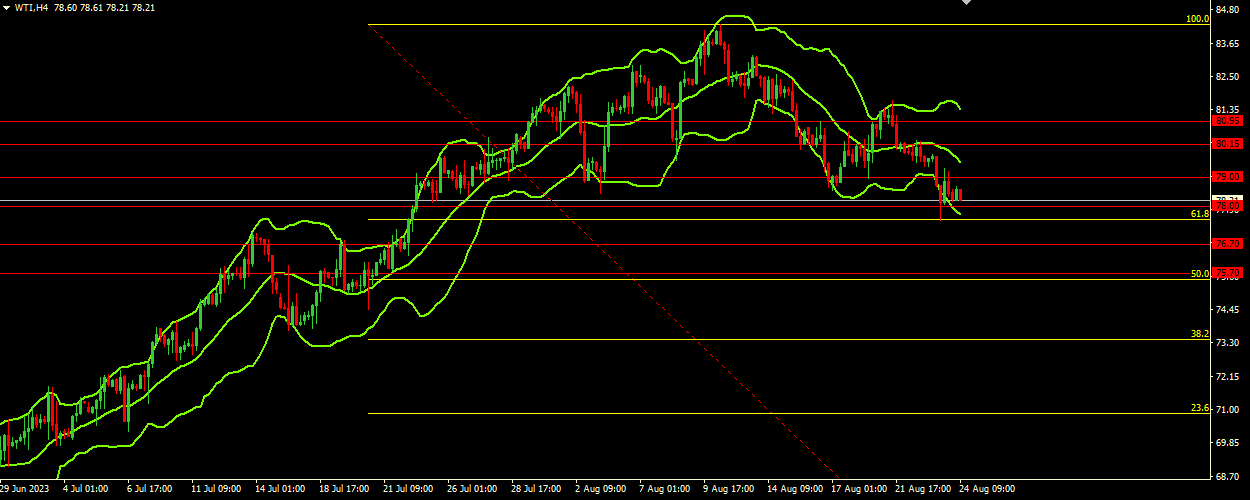
The Bollinger Bands show that price is in a relatively wide range. The upper band is located at $81.25 and the lower band is located at $77.70. The middle band, which acts as a moving average, is located at $79.55. The price is currently in the lower range of the bands, near the middle band, indicating bearish momentum. The downward direction of the bands suggests that the bearish trend may continue in the short term. Given the current downtrend and the price position within the Bollinger Bands, traders may consider entering a short position at the current price of $78.42 or expect a small pullback to the nearest resistance at $79.00.
Main Scenario (SELL)
Recommended entry level : 78.00.
Take Profit: 76.70.
Stop Loss: 78.50.
Alternative scenario (BUY)
Recommended entry level: 79.00.
Take Profit: 80.15.
Stop loss: 78.50.