
Fundamental analysis of EUR/USD
EUR/USD fell to a low of 1.07064 and is in correction, trading at 1.07300. The movement of currency pairs is influenced by various economic indicators and events.
In the focus of attention is the data on industrial orders in Germany, the decline in July amounted to 11.7%, which is significantly lower than the expected 4%. The decline is significant and may indicate an impending recession. However, it should be noted that the manufacturing sector accounts for less than a fifth of the German economy. Therefore, weakening orders will also not necessarily affect the European Central Bank's September strategy.
At the same time, attention will turn to retail sales in the eurozone. The upward trend of this indicator may indicate a possible further tightening of the ECB's monetary policy. Tightening in such conditions means higher interest rates, which may lead to a reduction in consumer spending and curb demand-driven inflation. ECB officials are stepping up efforts amid growing concerns about the possibility of a recession in the eurozone. ECB Executive Board member Elizabeth McColl will speak, and while her stance is dovish, it will be in stark contrast to Lagarde's softer stance.
In the US, the ISM non-manufacturing PMI figures are drawing attention. The market agrees that the Fed's interest rates will rise in the long term. Therefore, the PMI data should be in line with these expectations. The non-manufacturing PMI is expected to decline slightly to 51.0 from 52.3 in August. However, a significant decline in this indicator could signal the beginning of a recession in the US economy.
Several other indicators are also expected to be released, including the S&P Global Services trade statistics and Composite PMI. However, the focus remains on the ISM Non-Manufacturing PMI. Recent data shows that EUR/USD is struggling despite a slight drop in the US Dollar. This is largely due to disappointing data from Germany and economic problems in the Eurozone, as well as a relatively optimistic outlook for the US.
Global issues such as talk of stimulus in China's real estate sector have also played a role in influencing currency pairs. The market is currently awaiting more information on the US economic situation and a possible recession in the Eurozone to get clearer signals on the EUR/USD direction.
Technical analysis and scenarios:
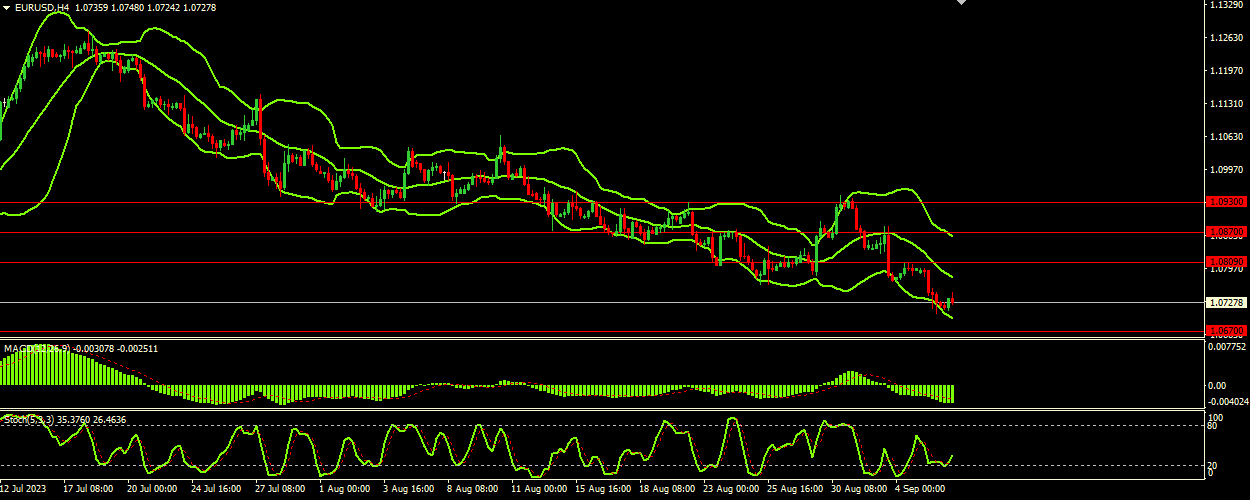
Price is within the lower range of the Bollinger Bands, which hints at potential undervaluation. The narrowing of the bands suggests a decrease in volatility, with price rising in the lower range. The middle band is set at 1.07800, which may act as a psychological resistance in the short term. The stochastic oscillator is currently at 37.8830, which is above the signal level of 27.2993. This indicates that the bullish momentum remains, but caution should be exercised as it is not yet in overbought territory. The MACD value is -0.003042, which is slightly below its signal of -0.002507. This indicates the presence of bearish momentum. Given that the price is near the lower Bollinger Band and the Stochastic indicates an upward momentum, an upward movement could occur in EUR/USD in the short term.
Main scenario (BUY)
Recommended entry level: 1.08090.
Take Profit: 1.08700.
Stop Loss: 1.07870.
Alternative
alternative scenario (SELL)
Recommended entry level: 1.06700.
Take profit: 1.06200.
Stop loss: 1.07000.