
Fundamental analysis of WTI
WTI crude oil prices declined on Tuesday, reaching 88.20.
As central banks, including the U.S. Federal Reserve and the European Central Bank, signal the possibility of a long-term interest rate hike, WTI crude oil prices are under significant pressure. With the oil market going through a turbulent period due to concerns that a rate hike will impact global economic growth, supply constraints should theoretically support black gold prices. Interruptions to the three-week uptrend have been largely influenced by concerns over rising interest rates and its impact on oil demand. Reinforcing these concerns, recent hawkish comments from the Federal Reserve made it clear that higher interest rates could increase borrowing costs, potentially slowing economic growth and thus reducing oil demand.
In addition, a strengthening US dollar exacerbates the situation by making oil more expensive for holders of non-dollar currencies, further reducing demand. Market uncertainty is further exacerbated by factors such as recent warnings from Moody's about the potential impact of the US government shutdown on the country's creditworthiness. This, along with past financial problems such as the debt ceiling crisis that led to a downgrade from Fitch, and turmoil in China's real estate sector, including the default on Evergrande bonds, further casts doubt on market psychology.
In contrast, the shortage of oil is readily apparent. Russia and Saudi Arabia, the two largest oil producers, have announced that they will limit oil production until the end of 2023 and have also imposed a temporary ban on exports of some fuels. The situation in the US is not much better, as the number of active oil rigs has fallen and refinery capacity has also declined. However, the short-term outlook does not look bright, with relief possible ahead of China's Golden Week, when a rise in tourism could push up oil prices.
In the coming days, the market will be closely watching data such as weekly API and EIA crude oil inventories, US consumer confidence, housing data and economic indicators. Important economic factors such as the US GDP and the PCE Core Price Index could have an impact on the dollar. In the tug-of-war between dwindling inventories and general concerns about the global economy, the balance is now tipped in favor of lower oil prices.
Technical analysis and scenarios:
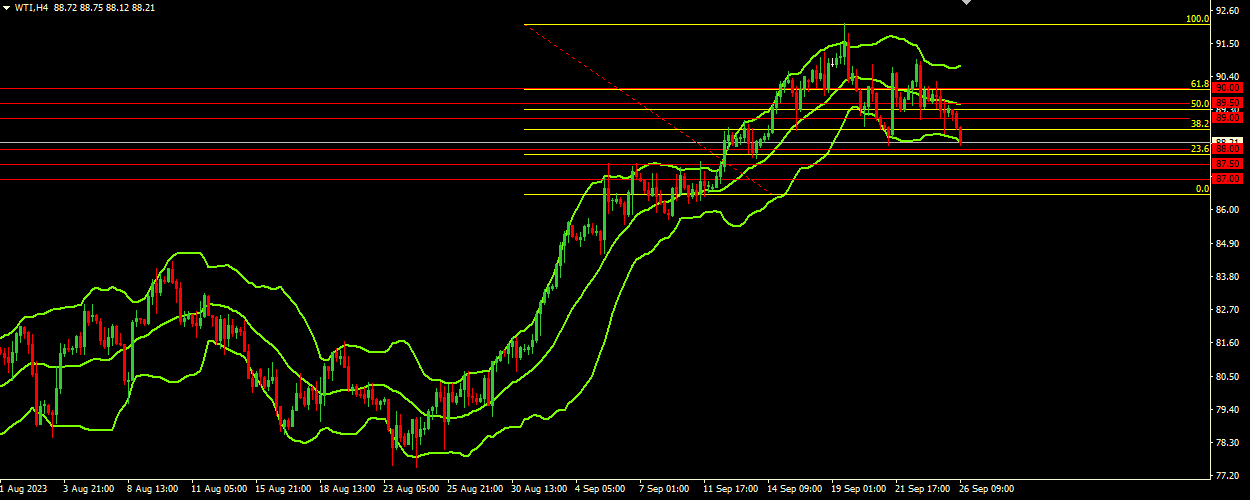
WTI is currently trading at 88.20, which is slightly above the lower Bollinger Band set at 88.25. Bollinger Bands with a wide price range indicate high volatility in the market. Given that price is below the middle band (set at 89.50) and declining, this suggests bearish momentum in the short term. Given that the price is trading just below the lower Bollinger Band, we can expect the downward dynamics to continue in the near term.
Main scenario (SELL)
Recommended entry level: 88.00.
Take Profit: 87.50.
Stop Loss: 88.25.
Alternative scenario (BUY)
Recommended entry level: 89.00.
Take Profit: 89.50.
Stop loss: 88.75.