
Fundamental analysis of WTI
WTI rose to $73.80 on Monday, but a combination of escalating tensions over the renewed trade dispute between the US and China and the possibility of further Fed policy tightening could disrupt the upward trajectory of oil prices.Global oil giants Saudi Arabia and Russia continue to cut production. U.S. crude oil inventories fell by 1.5 million barrels less than expected in the week to June 30. This significant decline indicates an increase in oil consumption during the summer peak season. Meanwhile, Reuters agreed with OPEC's optimistic outlook for oil demand next year, predicting modest but still above-average growth.
As for supply and demand dynamics, they continue to play a crucial role in determining the price of U.S. WTI crude futures. Although oil prices have fallen slightly from the highs reached on June 5, expected supply cuts by Saudi Arabia and Russia have helped limit the damage. On the supply side, Saudi Arabia has extended its production cuts by 1 million bpd through August, while Russia is set to cut oil exports by 500,000 bpd, planning to use the surplus to finance domestic fuel demand. On the demand side, China's oil prices fell in June by the most in seven years, signaling a possible slowdown in the economic recovery of China, the world's second-largest economy. Declines in the consumer price index (CPI) and producer price index (PPI) in June added to concerns about slowing economic growth in China, the world's second-largest economy. Tensions between economic uncertainty in China and demand concerns in Western countries, as well as OPEC's supply control strategy, continue to fuel market volatility. The total cuts by OPEC+, which includes OPEC and its allies, amount to about 5 million barrels per day, or about 5% of global oil demand.
Therefore, WTI crude oil price movements continue to be driven primarily by supply and demand dynamics. Proactive supply cuts by Saudi Arabia and Russia provide protection against potential losses. However, concerns about a slowdown in China add another layer of uncertainty to the market. The market's trajectory depends on the delicate balance between supply adjustments and shifting demand trends as investors eagerly await key economic data. Next week will see the release of crude oil inventories, Baker Hughes oil rig count, US CFTC positioning data, CPI, PPI and preliminary consumer sentiment data from the US University of Michigan (July), which could have a significant impact on the WTI price in USD.
Technical analysis and scenarios:
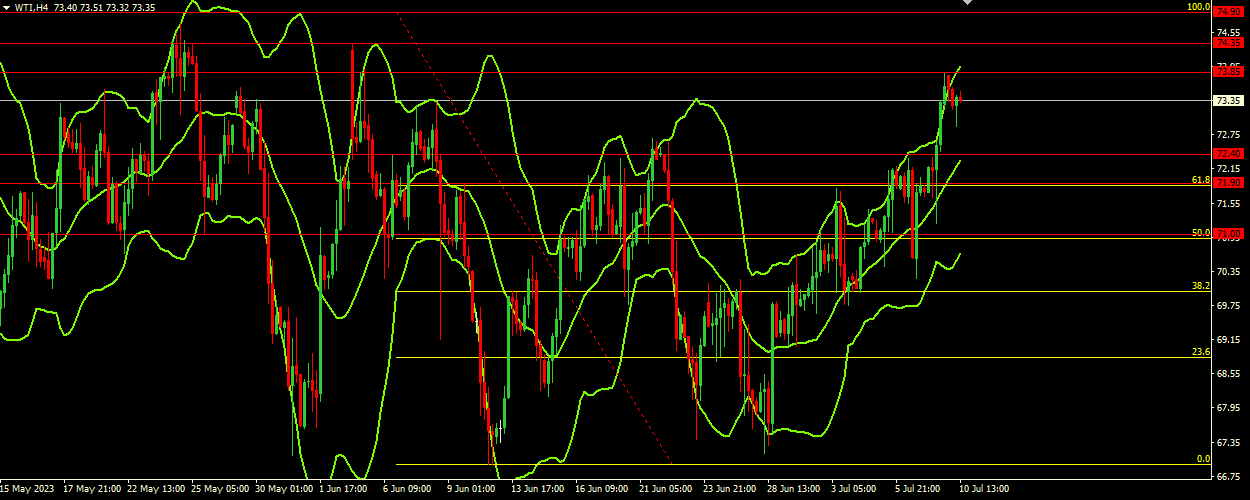
Based on the current WTI price hovering around $73.40, upward pointing Bollinger Bands and a wide price range, the main technical scenario suggests that oil prices will continue to rise. The price is currently closer to resistance levels, which increases the chances of reaching these levels and continuing the uptrend, especially given the upward bias of the Bollinger Bands. However, any significant bearish news could easily reverse this trend.
Main scenario (BUY)
Recommended entry level: 73.85.
Take Profit: 74.90.
Stop Loss: 73.30.
Alternative scenario (SELL)
Recommended entry level: 72.40.
Take Profit: 71.00.
Stop loss: 73.30.