
Fundamental analysis of WTI
WTI crude oil prices experienced a roller coaster ride during Thursday's session, driven by a number of economic factors. Crude oil prices initially rose as they rebounded from support from the Energy Information Administration (EIA), which reported that U.S. crude inventories unexpectedly declined by 9.63 million barrels for the week ended June 23.
However, WTI crude oil prices fell during the session, partially reversing the previous increase. The pullback was caused by the fact that investors decided to lock in profits because of concerns over the possibility of an interest rate hike in the U.S. and Europe. Market fears over a rate hike were fueled by statements from leading central banks, including Federal Reserve Chairman Jerome Powell, European Central Bank President Christine Lagarde and European Central Bank President Christine Lagarde. Bank of England Governor Andrew Bailey. Together, these leaders stated the need for policy tightening to combat persistent inflation in their countries, implying that monetary conditions are likely to continue to tighten in the near future.
Another negative factor affecting crude prices is weak economic data from China. As the world's second largest economy, China's fiscal strength plays an important role in stimulating global demand for fuel. Unfortunately, China is facing economic problems. This is partly due to weak demand and low profitability. In addition, the change in market dynamics, with Brent crude oil prices falling for six months and reaching their lowest level since December, points to an increase in spot demand. This could be due to the start of the U.S. driving season, which often increases fuel consumption. However, there remains uncertainty about the trajectory of the global economy in the second half of the year, which could negatively affect oil demand. To combat falling oil prices, Saudi Arabia promised in July to drastically cut production as part of an OPEC+ agreement to cut supply by 2024. Meanwhile, U.S. energy companies showed a decline in oil and gas drilling.
Thus, WTI crude oil prices are under downward pressure due to a combination of factors, including global economic uncertainty, potential interest rate hikes and weak economic data from China. Despite a concerted effort to limit oil supplies, weak fuel demand and an increase in electric vehicles are keeping prices from taking off. Investors and market participants should be cautious about these different dynamics and uncertainties.
Technical Analysis and Scenarios:
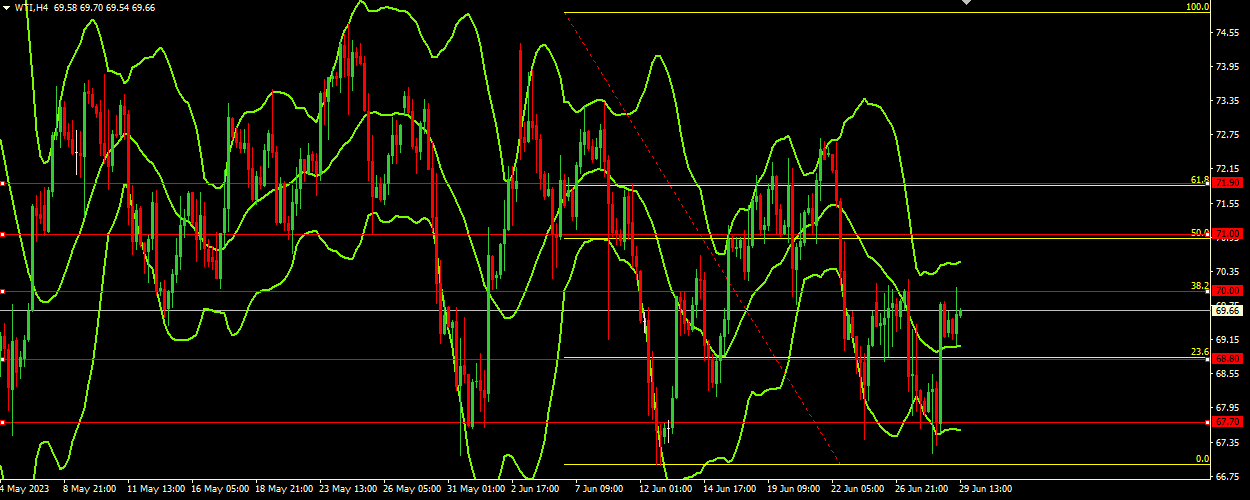
The Bollinger Bands indicator suggests a horizontal direction, indicating that price may continue to trade in a range in the short term.
Main scenario (BUY).
Recommended entry level: 68.80.
Take Profit: 71.00.
Stop loss: 67.50.
Alternative scenario (SELL)
Recommended entry level: 68.80.
Take Profit: 67.70.
Stop loss: 69.20.