
Fundamental analysis of WTI
Oil prices are pulling back from recent 10-month highs, with benchmark WTI crude holding near $89.00, although it has reached its highest since November 2022 at 92.16.
Such market dynamics is due to several factors. As the next US Federal Reserve interest rate decision approaches, speculation is becoming more frequent. Although the consensus expects interest rates to remain at 5.25-5.5%, all eyes are on the comments of Fed Chairman Jerome Powell. Any sign of continued high interest rates could lead to higher borrowing costs, a deteriorating economy and lower oil demand. According to a report from the American Petroleum Institute, inventories fell by 5.25 million barrels last week. This decrease was well above market expectations, which had expected a decrease of about 2.5 million barrels.
Supply constraints are adding to market tensions. Saudi Arabia and Russia, two of the world's oil giants, have decided to extend production curbs until the end of 2023. Saudi oil production is expected to remain at 1.3 million bpd during this period. Such voluntary restrictions, as well as others that Russia may impose, have heightened fears of a tightening oil market. To address domestic fuel shortages, Russia is even considering a significant increase in export duties on petroleum products. In addition, the International Energy Agency, citing production cuts, is sounding the alarm about the possibility of a growing shortage in the oil market in the upcoming fourth quarter. Another concern is shale oil production in the US. Production is expected to fall to its lowest level since May 2023. However, a positive side is emerging as Exxon Mobil Corp has shown willingness to increase oil production in Nigeria.
Market sentiment, while reflecting recent volatility, remains largely optimistic. Forecasts indicate that Brent and WTI crude oil prices could reach the 100.00 mark by the end of this year due to continued tight supply and stable global demand. It should be noted that India's oil imports are declining, affected by both maintenance work and reduced supplies from Russia.
Thus, the current trajectory of the oil market is likely to be subject to short-term fluctuations, largely dependent on Federal Reserve decisions and geopolitical factors. However, the overall picture of winter supply shortages, combined with low global demand, sets the stage for further upward pressure on oil prices. As events such as the Fed meeting and the release of US crude oil inventories data unfold, traders will pay attention to clues and potential trading opportunities in the oil sector.
Technical Analysis and Scenarios:
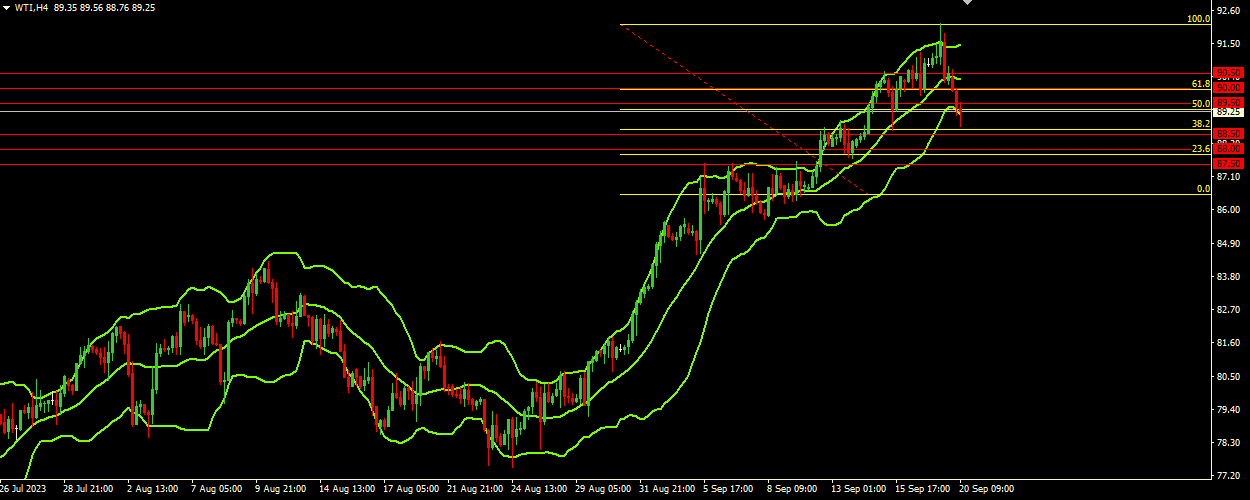
Given the current technical indicators and price position, bearish sentiment prevails. Price has approached the lower Bollinger Bands at 89.15 and is currently trading just below the middle band, indicating the possibility of further declines. The direction of the Bollinger Bands and the widening price range reinforce the bearish sentiment.
Main scenario (SELL)
Recommended entry level: 88.50.
Take Profit: 88.00.
Stop loss: 88.80.
Alternative scenario (BUY)
Recommended entry level: 89.50.
Take Profit: 90.00.
Stop loss: 89.20.