
Fundamental analysis of EUR/USD
EUR/USD underwent significant fluctuations on Wednesday and eventually fell to 1.05620.
The dynamics of the German economy, which has been in the spotlight lately, showed downward trends in line with the pessimistic macroeconomic backdrop combined with concerns about interest rates and the labor market, weakening German consumer confidence, whose data came in below expectations at -26.0 to -26.5. The sharp decline points to the possibility of a reduction in consumer spending, which in turn would reduce inflationary pressures. With private consumption in Germany accounting for more than half of the economy, the decline in spending confirms the already gloomy economic outlook.
The expected ECB interest rate hike coupled with the unfavorable macroeconomic situation is expected to put pressure on the EUR/USD pair. Further fluctuations of the currency pair will be determined not only by statistical data, but also by the ECB statements. If the ECB takes a hawkish stance in this gloomy economic situation, it could push the EUR/USD pair towards parity. Finally, investors will be keeping a close eye on the large volume of durable goods orders. If orders unexpectedly decline, it could raise concerns about a possible recession in the US economy, especially in light of recent services PMI data and statistics indicating that consumer confidence has fallen to below-average levels. While forecasts suggest a marginal 0.1% increase in core durable goods orders in August, any deviation could spark talk of a recession.
However, the U.S. Federal Reserve could lower these numbers as the U.S. manufacturing sector accounts for only a small portion of GDP. Since the main inflationary forces come from the service sector and personal consumption, higher interest rates are likely to offset tightening labor market dynamics and wage growth. Slower wage growth could lead to lower consumer spending, further dampening demand-driven inflationary pressures. The strength of the dollar is evident as it continues to rise, supported by growing expectations that the Federal Reserve will keep interest rates high for an extended period of time.
As the U.S. economy shows resilience and the Eurozone prepares for a major recession, there is clarity on monetary policy and economic divergence. Further reinforcing the bearish sentiment towards EUR/USD, the pair seems to be stuck in a range of lows since mid-March. The sustained strengthening of the US dollar, supported by the hawkish stance of the Federal Reserve and persistent inflation concerns, puts EUR/USD in a precarious position. Recent statements by some Fed officials, combined with the strength of the US economy, support the possibility of policy tightening. At the same time, weak risk appetite coupled with concerns about the Chinese real estate sector and the burden of rising borrowing costs cast a shadow over risky assets. Recent dovish ECB decisions and revised GDP and CPI growth forecasts for the coming years further tip the scales in EUR/USD's favor.
Looking ahead, market participants will follow the release of US durable goods orders data, as well as the speech by Fed Chairman Jerome Powell.
Technical analysis and scenarios:
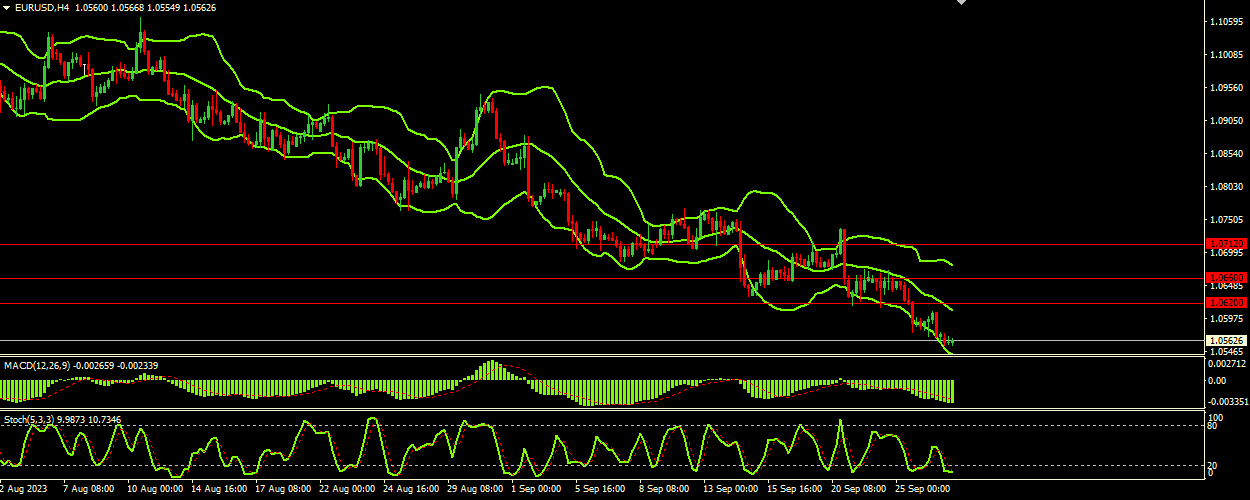
The price of the pair "hovered" near the lower band, which indicates a strong bearish impulse. The bands are directed downward, and their width indicates increased volatility. The middle band (1.06110) acts as a short-term resistance. With a value of 10.0509 and a signal of 10.7558, the stochastic is deep in oversold territory. Normally, this would indicate a potential reversal to the upside. However, given the overall bearish context, it could mean that bearish momentum is strong. A MACD value below its signal line and also below the zero line suggests that bearish momentum persists.
Main Scenario (SELL)
Recommended entry level: 1.05400.
Take Profit: 1.04900.
Stop Loss: 1.05700.
Alternative scenario (BUY)
Recommended entry level: 1.06200.
Take Profit: 1.06600.
Stop loss: 1.06000.