
Fundamental analysis of WTI
WTI crude oil prices strengthened and rose in recent trading, reaching 75.40, reflecting a combination of global economic uncertainty in supply and demand and geopolitical tensions.
The market is currently facing a number of challenging situations ranging from geopolitical uncertainty in the Middle East and the ongoing Russia-Ukraine conflict to unfavorable weather conditions affecting oil production. A major incident illustrating the current uncertainty is the Ukrainian drone attack on Novatek's fuel port in Ust-Luga. This incident caused temporary disruptions to exports and left wartime infrastructure vulnerable, while U.S. oil production has fallen sharply due to the harsh winter.
Domestic problems are tempered by concerns about the weakness of China's economy and its impact on oil demand, as China is the world's largest oil exporter. Making matters worse, U.S. and British troops struck underground Houthi storage facilities in response to attacks on ships in the Red Sea. These events have raised concerns about the safety of international transportation and inflation. In addition, the oil market is awaiting the release of important information that is expected to affect market sentiment, such as a report from the American Petroleum Institute and information on changes in oil gathering from the U.S. Energy Information Administration.
Despite these issues, short-term market sentiment is on the rise due to the absence of recession fears and geopolitical tensions. However, it is worth noting that short-term oil prices are more influenced by quick trends than fundamental analysis. Overall, global oil markets are also affected by a 270,000 barrels per day increase in production following the startup of the Sharara oil field in Libya.
Overall, current oil market conditions are balanced by declining crude oil inventories in the US and expectations of growth in major economies such as China and Europe, as well as demand growth forecasts.
Technical analysis and scenarios:
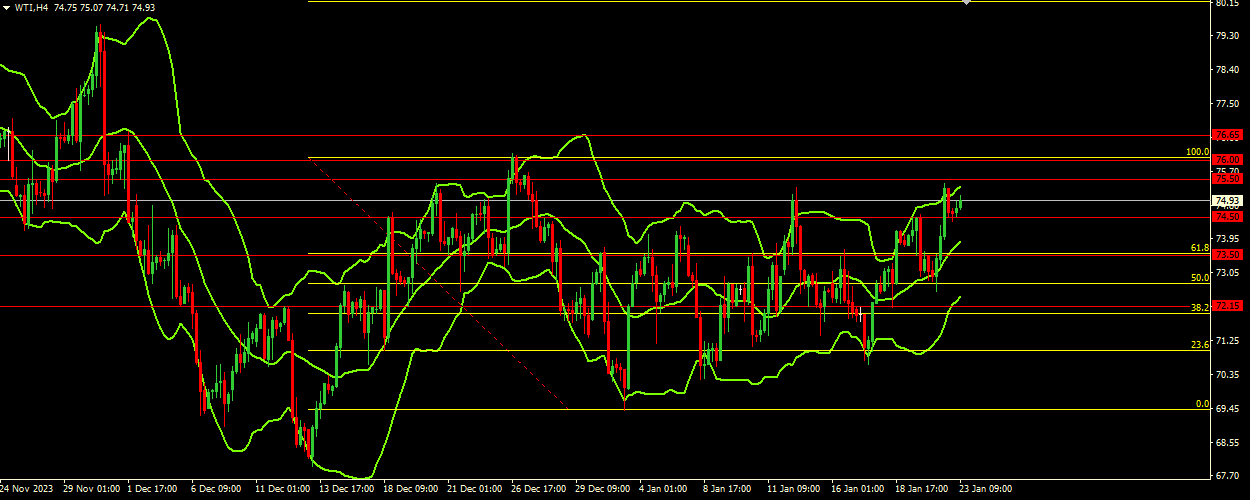
The upper Bollinger band is at 75.30, the middle band is at 73.85 and the lower band is at 72.50. Bollinger Bands are used to identify overbought and oversold conditions in the market. The fact that the price is rising in the upper range of the Bollinger Bands, near the upper band, indicates that WTI is currently trading in a relatively high price range. The upward direction of the indicator and the narrowing of the price range may indicate a decrease in volatility. The proximity of the current price to the upper band indicates bullish momentum, but also warns of potential overbought conditions.
Main scenario (SELL)
Recommended entry level : 74.50
Take Profit: 73.50
Stop Loss: 75.00
Alternative scenario (BUY)
Recommended entry level: 75.50
Take Profit: 76.00
Stop loss: 75.25