
Fundamental analysis of USD/JPY
The USD/JPY has recently corrected slightly after reaching resistance around 143.50 in early London time trading. However, the upward momentum of USD/JPY remains unchanged, mainly due to the negative market sentiment, which increased the attractiveness of the US dollar.
Investor interest in the restrictive monetary policy of central banks around the world is an important factor contributing to such sentiment. These concerns, in particular, have led to significant losses in S&P 500 futures in Asia, reinforcing fears of a global economic slowdown. As further rate hikes are expected to offset continued inflation, markets are watching the Federal Reserve's actions particularly closely.
As the U.S. economy recovers, the Labor Department released data showing that initial jobless claims increased slightly for the week ended June 16. At 260,000, higher than expected.
The economic data on the Japanese side shows a different picture. Despite continued monetary stimulus from the Bank of Japan (BoJ), inflationary pressures in Japan have unexpectedly eased. Core inflation fell to 3.2%, contrary to market expectations of a 4.1% increase. Excluding highly volatile food and oil prices, core inflation was 4.3%, slightly below the 4.4% forecast, but above the previous estimate of 4.1%. .
In addition, Japan's private sector performance, especially the manufacturing sector, fell short of expectations. The purchasing managers' index (PMI) of the manufacturing sector rose from 50.6 to 49.8, indicating a contraction, while the service sector PMI also fell from 55.9 to 54.2. As a result, total output increased at the slowest pace in four months, while new orders and private export orders declined. While relatively high core inflation will prompt the BoJ to revise its ultra-soft monetary policy, disappointing PMI data, combined with the economic situation in China, may encourage the BoJ to maintain its current stance. The Bank of Japan is pursuing a very accommodative monetary policy and recently reiterated that view. Market participants expect possible changes to the BoJ's yield curve control policy which currently caps 10-year bond yields at 0%. Recent economic data will play an important role in the Bank of Japan's future policy. Therefore, the trajectory of the USD/JPY pair is influenced by opposing economic developments in the US and Japan. The US Dollar is benefiting from market uncertainty and hawkish monetary policy expectations from the Fed, while the Japanese Yen is facing deflationary pressures and a potentially long-term dovish stance from the Federal Reserve Bank of Japan.
If market sentiment continues to favor the U.S. dollar due to further signs of a hawkish Federal Reserve policy, and if the Bank of Japan shows signs of maintaining or expanding its accommodative stance, an extended bullish trend is possible.
Technical analysis and scenarios:
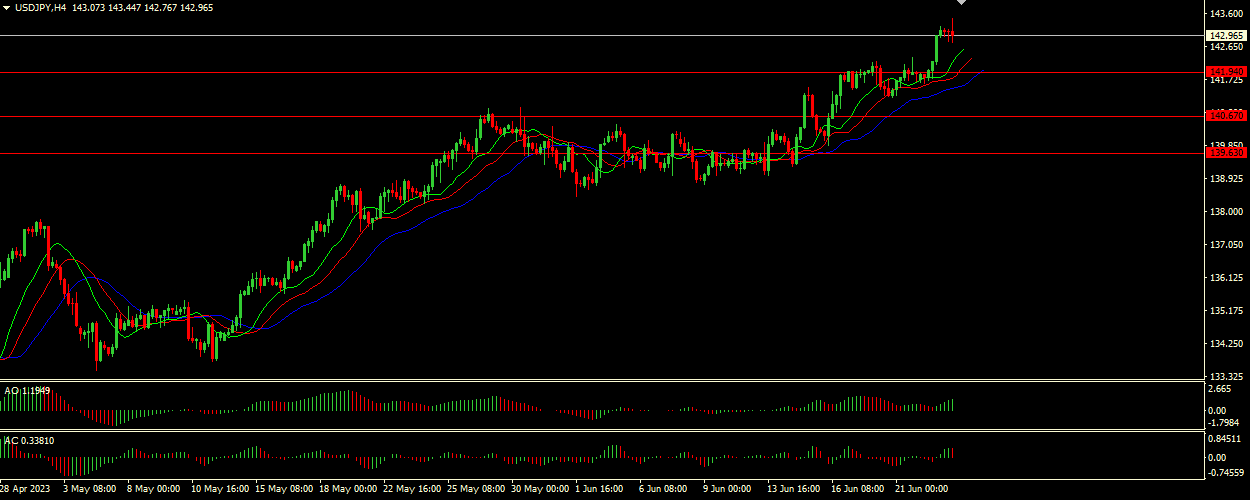
The Alligator indicator indicates an uptrend because its jaw is wide open and its jaw (blue line) is below the lips and teeth (green and red lines).
Given this, the main scenario would be to go long (buy) on the USD/JPY pair. However, since Awesome Oscillator (AO) and Accelerator Oscillator (AC) show divergence, it is important to proceed with caution, as it may not be a strong signal for entry.
Recommended entry level (BUY): 143.600.
Take Profit: 144.800.
Stop Loss: 142.500.
Recommended entry level (SELL): 143.400.
Take Profit: 142.200.
Stop Loss: 144,000.