
Fundamental analysis of EUR/USD
The EUR/USD has experienced a clash between various economic factors. One factor supporting the euro is the expectation that the European Central Bank (ECB) will raise its benchmark interest rate by 25 basis points in July. This was supported by the latest Eurostat report, in which the Harmonized Index of Consumer Prices (HICP) of the Eurozone fell to 5.5% in June from 6.1% year-on-year.
On the other hand, EUR/USD is under pressure from a stronger U.S. dollar. The Fed's hawkish stance, backed by Fed Chairman Jerome Powell, raises the likelihood of a 50 basis point increase in borrowing costs by the end of the year. The market also believes there is an 85% chance of a 25 basis point rate hike at the next meeting in July. Although the PCE annual price index fell to 3.8% in May, it was still well above the Fed's 2% target. U.S. monetary policy tightening is holding EUR/USD back.
Key macroeconomic releases are in focus this week, including minutes of the US manufacturing PMI from ISM and FOMC, as well as the highly anticipated monthly US employment data. PMIs from Spain, Italy, France, Germany and the Eurozone affect the EUR/USD exchange rate. However, the PMIs from Italy and the Eurozone will have a greater impact. In addition to the main PMI, investors are also interested in sub-components such as employment, new orders, production costs and ex-factory prices.
China's private sector PMI data also plays an important role. The manufacturing PMI index declined more modestly than expected in June, which was positively perceived by investors, indicating potential support from the NBK to stimulate economic activity.
In short, the EUR/USD is being affected by a number of factors, including possible ECB and Fed rate hikes, European and Chinese manufacturing data and major U.S. economic announcements.Traders should approach the market with caution as the pair continues to be in a tight quadrant amid these conflicting pressures.
Technical analysis and scenarios:
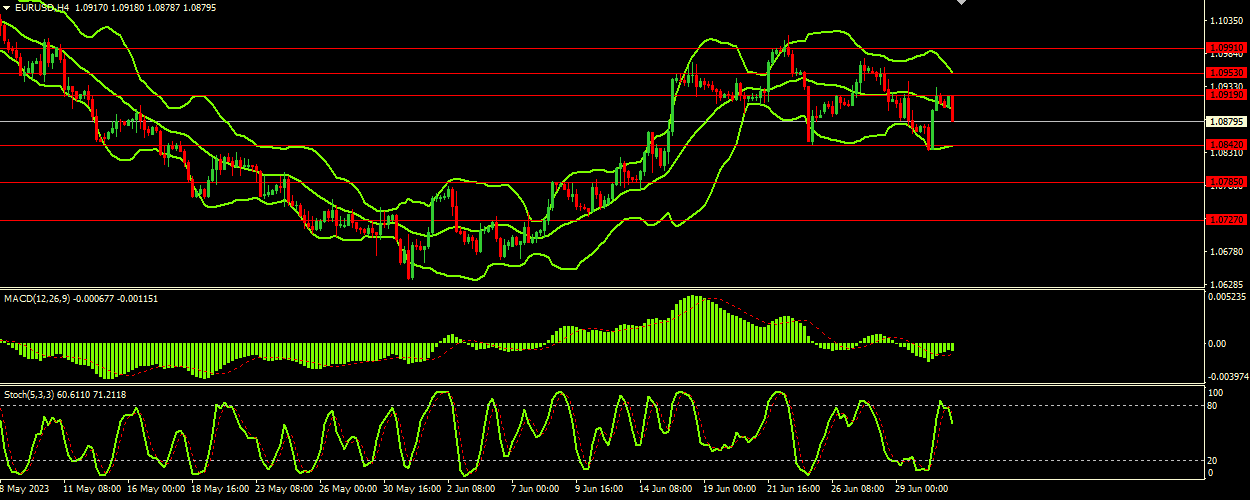
Technical indicators show that the pair is trading near the lower boundary of the Bollinger Bands (1.08420), which coincides with the first support level. Stochastic indicates that the pair is not yet in oversold territory, which suggests that there is room for further downside. MACD is below the zero line and the signal line, supporting a bearish mood.
Main scenario (SELL)
Recommended entry level: 1.08420.
Take Profit: 1.07850.
Stop loss: 1.08800.
Alternative scenario (BUY)
Recommended entry level: 1.09190.
Take profit: 1.09910.
Stop loss: 1.08800.