
Fundamental analysis of EUR/USD
The EUR/USD seems to be gaining momentum, aiming for a break above 1.09000 at the start of the European session. The euro's strengthening may be due to pressure on the US Dollar Index (DXY), which is declining despite the Fed's likely 25bp rate hike in July.
Financial markets are closely watching the U.S. non-farm payrolls (NFP) data, which is expected to add 225,000 jobs from the previous 339,000. The unemployment rate is expected to be 3.6%, up from 3.7% previously. This figure is important because it shows the strength of the U.S. labor market, which is holding up despite rising interest rates and tightening credit conditions. In contrast, the economic health of the eurozone is also under scrutiny, especially Germany, the bloc's largest economy. The latest data showed that German industrial production fell 0.2 percent, well below the small 0.1 percent gain expected. Nevertheless, German factory orders were positive, indicating the potential for a recovery in the manufacturing sector. As the German economy remains in focus, comments from the ECB, especially from ECB Executive Board member Luis de Guindos and ECB President Christine Lagarde, will be closely watched.
In addition, expectations of a possible ECB rate hike are rising as inflationary pressures in Europe persist. In this regard, the location and contacts of President Christine Lagarde will be important.
In the US, employment data is likely to influence the Fed's stance on monetary policy. The recent strong economic data raised the odds of a rate hike in July, with CME FedWatch showing a 90.5% to 91.1% chance. However, to change our view on a rate hike in September, the jobs report would have to reflect the positive tone of the ADP report and point to wage growth momentum. The current probability that the Fed will raise rates to 5.75% in September is 26.4% versus 18.1%. In addition to the Eurozone and U.S. data, global geopolitical factors such as trade developments between the U.S. and China should also be considered. This is because these factors could have a significant impact on the EUR/USD exchange rate.
Therefore, a number of factors could affect the EUR/USD pair behavior, including U.S. labor market data, the Fed and ECB monetary policy stance, German economic data and global geopolitical events. Investors and traders should be cautious and closely monitor the situation.
Technical analysis and scenarios:
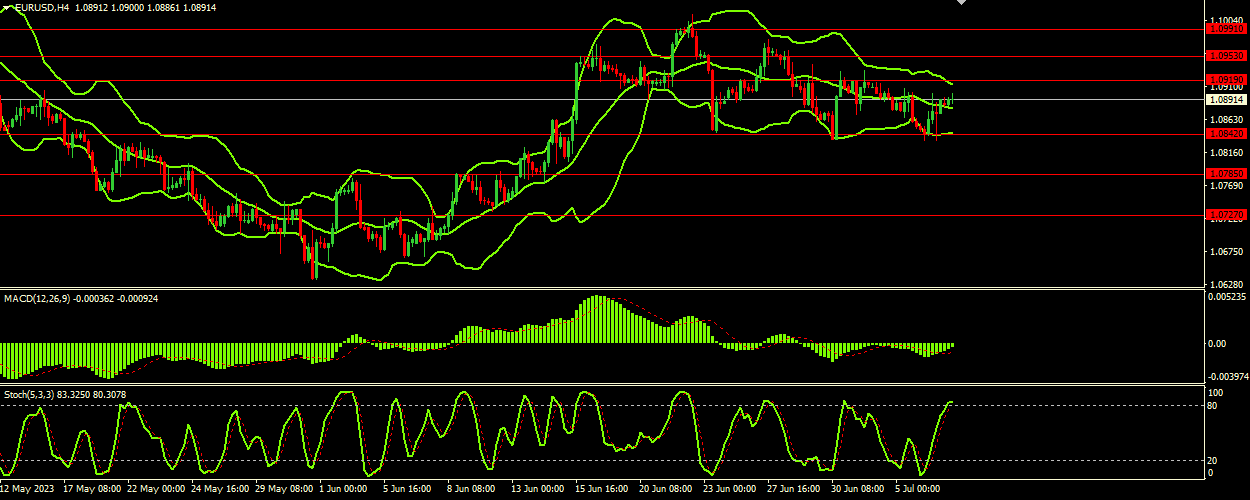
The EUR/USD seems to have gained momentum and is approaching resistance levels. The Stochastic Oscillator at 85.22 and above the signal line (80.94) indicates that the pair is in overbought territory, which can sometimes be a sign of a potential short-term correction or consolidation.
The Bollinger Bands show that price is moving in the upper range, which is a sign of upward strength. However, the bands are narrowing, indicating a possible decline in volatility.
The MACD line is close to crossing over the signal line, which usually indicates a bullish trend, but both are near zero, which may also indicate a lack of strong momentum.
Main scenario (BUY)
Recommended entry level: 1.09190.
Take Profit: 1.09910.
Stop loss: 1.08800.
Alternative scenario (SELL)
Recommended entry level: 1.08420.
Take profit: 1.07850.
Stop loss: 1.08800.