
Fundamental analysis of USD/JPY
During Friday's active session, the USD/JPY currency pair behavior was influenced by several economic factors in Japan and the United States, as well as geopolitical considerations.
Starting from Japan, household spending data attracted attention. Economists were expecting household spending to rise by 0.5 percent in May compared to a 1.3 percent decline in the previous month. However, on a year-over-year basis, a 2.4 percent decline is expected, which is better than April's 4.4 percent decline. Rising household spending may prompt the Bank of Japan to revise its very loose monetary policy. The Japanese yen has also strengthened and Japanese authorities have signaled they are ready to step in and stabilize the currency if necessary. Encouraging wage growth data in May and positive preliminary results from the coincident and leading economic indicators further strengthened the yen. Although the Bank of Japan downplayed the need for immediate changes, discussions about a possible abandonment of loose monetary policy and yield curve controls (YCC) drew traders' attention.
Turning to the U.S., the main event of the day will be the promising U.S. jobs report. A significant increase in non-farm payrolls and a sharp rise in wages is expected, which may further fuel rumors of a further Fed rate hike. Specifically, economists expect the number of nonfarm payrolls to increase by 225,000 in June and wages to rise 4.2% year-over-year. In light of the positive developments in the ADP Non-Farm Payrolls and ISM Non-Manufacturing PMI reports, market sentiment has shifted toward a more positive view of Fed stocks.
Complicating things is that while talk of Bank of Japan intervention may limit the upward momentum of USD/JPY, news on trade relations between China and the United States cannot be ignored. As for the general market sentiment, US and Asia-Pacific stock futures were under pressure and suffered losses on Wall Street. In addition, U.S. Treasury yields rose, pushing 10-year and 2-year bond yields to three-month highs. Market sentiment remains bearish as investors remain cautious ahead of the Q2 earnings season and labor market data.
Overall, the USD/JPY pair faces multiple factors, with Japanese and US economic data, central bank policy and geopolitical considerations playing an important role in pricing.
Technical analysis and scenarios:
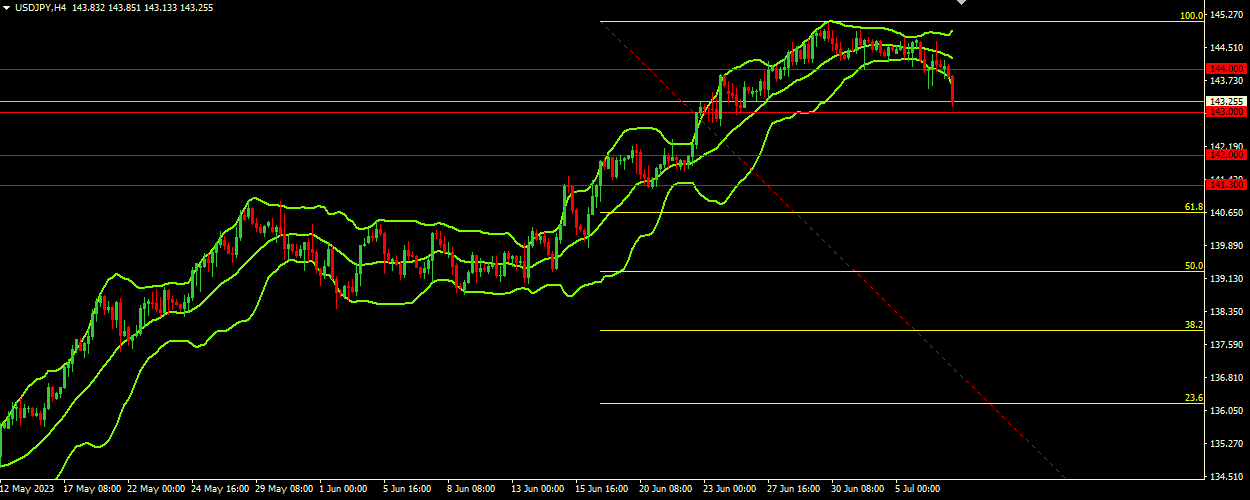
The USD/JPY pair has support levels at 143.000, 142.000 141.300 and resistance levels at 145.000, 144.500 and 144.000.
The Bollinger Bands are located with the upper band at 144.890, the middle band at 144.270 and the lower band at 144.630. The bands are widening and pointing down, which usually indicates increased volatility and a possible continuation of the downtrend. The price is currently below the lower Bollinger Band, indicating that it is in a declining phase.
Main scenario (SELL)
Recommended entry level: 143.000.
Take Profit: 142.000.
Stop loss: 143.500.
Alternative scenario (BUY)
Recommended entry level: 144.000.
Take Profit: 145.000.
Stop loss: 143.500.