
Fundamental analysis of WTI
Oil prices have shown notable movement this week, with Brent remaining above 90.00 and WTI holding near 87.00.
The recent rise in oil prices for both benchmarks is largely due to the decision by Saudi Arabia and Russia to extend voluntary supply cuts through 2023 totaling up to 1.3 million barrels per day. Despite WTI's bullishness and rise to its highest level since November 2022, global markets are behaving cautiously. This caution is due to the anticipation of key macroeconomic data releases and lingering concerns about interest rate hikes in Europe and the US. The central indicator is the U.S. Consumer Price Index for August, which is scheduled for publication on Wednesday. Its consequences may significantly affect the trajectory of interest rates and, consequently, the demand for oil. On the one hand, Europe is preparing for the refinery overhaul season this fall.
In contrast, in the US, thanks to positive economic data released last week, the likelihood of an interest rate hike before the end of the year remains high. As higher interest rates could increase borrowing costs, there is a risk of an economic slowdown, which could reduce oil demand.
China, the world's largest oil importer, helped WTI rise slightly thanks to the August consumer price index report. The data showed a 0.1% year-on-year increase, better than the 0.3% decline in the previous month. The easing of deflation fears in China indirectly supported WTI crude oil prices.
More broadly, reports from industry giants such as the International Energy Agency and the Organization of the Petroleum Exporting Countries are expected to influence the discussion. The IEA recently revised downward its oil demand growth forecast for 2024, citing sluggish macroeconomic conditions, while OPEC maintained its growth forecast of 2.25 million bpd for the same period.
During the week, oil traders around the world will be keeping a close eye on the weekly crude oil inventory data from API, crude oil stockpile trend data from EIA and, more importantly, the US consumer price index, which is expected to be announced on Wednesday. This data could significantly impact the WTI price in USD, creating potential trading opportunities.
Technical Analysis and Scenarios:
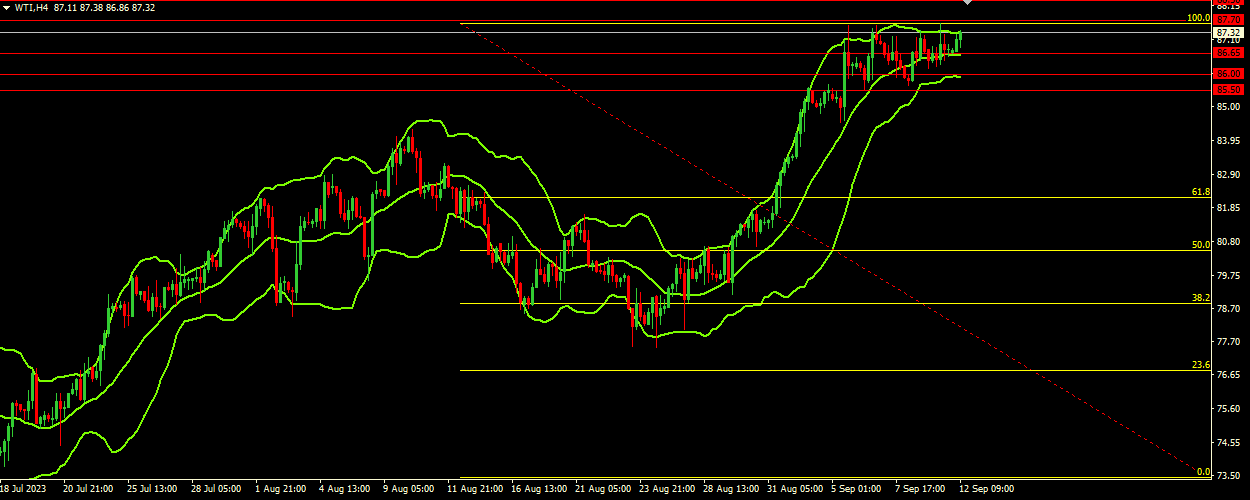
WTI is trading at 87.25, slightly below the first resistance level of 87.70 and almost kissing the upper Bollinger Bands located at $87.30. The horizontal direction of the Bollinger Bands suggests a relatively stable market. However, the proximity of the price to the upper band indicates some buying pressure. The price behavior around the Bollinger Bands will be crucial in the coming days. If the price continues to stay near the upper band, it may indicate that the buying pressure remains and a bullish scenario may be realized. If the price falls below the middle band, it would indicate that selling pressure is intensifying and a bearish scenario may be on the horizon.
Main scenario (BUY)
Recommended entry level: 87.70.
Take Profit: 88.30.
Stop loss: 87.40.
Alternative scenario (SELL)
Recommended entry level: 86.65.
Take Profit: 86.00.
Stop loss: 86.95.