
Fundamental analysis of AUDUSD for 27.02.2024
The Australian Dollar (AUD) continues its downward trend for the second consecutive day due to the lower S&P/ASX 200, tracking overnight losses on Wall Street. In addition, investors will remain cautious ahead of key economic data releases from Australia and the United States, looking for insights into the monetary policy outlook in both countries.
Australia's consumer confidence index, measured by ANZ-Roy Morgan, remained largely unchanged this week at 83.2. This is the 56th consecutive week that the index has been below the benchmark 85. The index is just 0.4 points below the 2024 weekly average of 83.6. Investors are now looking forward to Wednesday's release of Australia's monthly consumer price index and Thursday's retail sales figures for further insight into the economic situation.
Forecasts regarding interest rate decisions by central bank (RBA) have been subject to adjustments by leading economists. TD Securities has revised its projections for the Reserve Bank of Australia's cash rate cuts, now expecting the first 25 basis points reduction to occur in November, compared to a previous forecast in August.
The US dollar index (DXY) held firm after stabilizing following recent declines despite a rise in US yields, likely reflecting improved risk sentiment. Federal Open Market Committee (FOMC) minutes propose reaffirming the Fed's data-driven approach. New York Fed President John C. Williams explained his views on the Fed's interest rate policy in an interview with Axios. He hinted at the possibility of a rate cut this year, but stressed that a rate cut would only occur if deemed appropriate.
Federal Reserve President Christopher J. Waller recently suggested that the Fed should hold off on cutting rates for at least a few more months to assess whether January's high inflation report was an anomaly. US President Joe Biden will meet with the four leaders of the conference at the White House on Tuesday. Discussions will focus on passing the National Security Bill and ensuring that the government continues to function. Friday's deadline is approaching.
US economic data revealed that new home sales reached an annual pace of 661,000 units during January, an increase of 1.5% from December’s upwardly revised reading of 651,000 units, and compared to expectations that expected 680,000 units to be recorded.
Upcoming Australian inflation data and US consumer confidence data may continue to shape market sentiment and may influence monetary policy decisions. Additionally, FOMC members' speeches are expected to provide additional guidance on the inflation outlook and interest rate adjustment schedule, which will further impact the short-term trend in AUD/USD.
Technical analysis and scenarios:
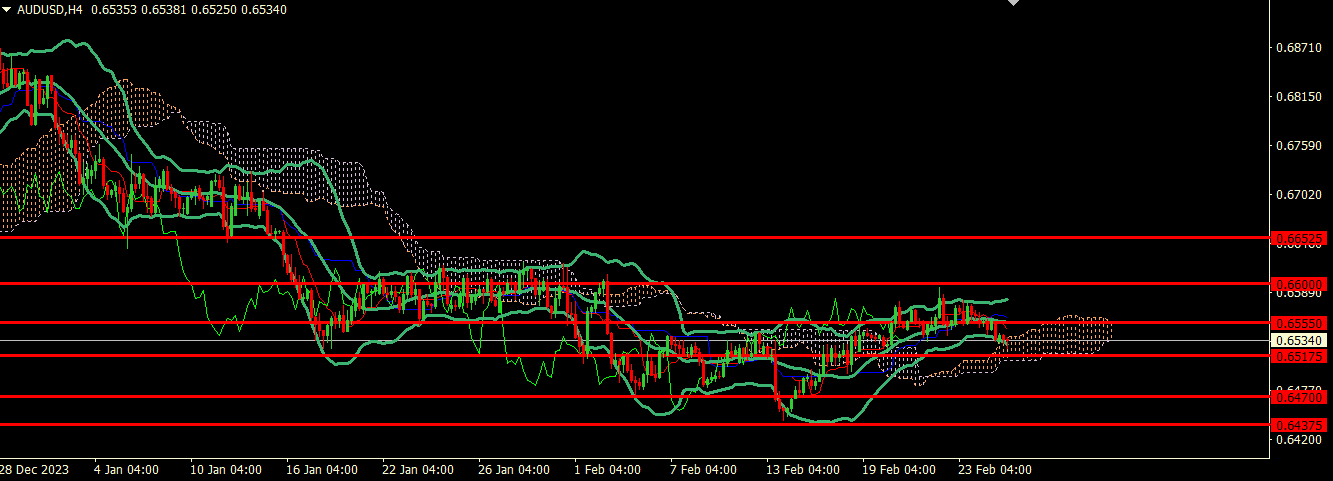
The price is currently near the lower band of the Bollinger Bands, indicating a potential oversold condition.
The Bollinger Bands are wide, suggesting increased volatility in the market.
Main scenario (BUY)
Recommended entry level: current price
Take profit: 0.66000
Stop loss: 0.65175
Alternative scenario (SELL)
Recommended entry level: 0.65175
Take profit: 0.64700
Stop loss: 0.65550