
The dollar index is recovering its position
The dollar index is recovering its position
Last week, the dollar index recorded a decrease of 0.4%. Thus, over the past two weeks, the American currency has declined by more than 0.8%. At the same time, the dollar index has been continuously decreasing for 7 weeks in a row.
The reason for the decline in the US currency's exchange rate is weak statistical data indicating a gradual slowdown in the US economy. Against this backdrop, the Federal Reserve System (FRS) is increasingly signaling a possible end to the cycle of tightening monetary policy. Meanwhile, other leading central banks continue to tighten monetary policy to reduce inflationary pressure.
There is currently no consensus within the leadership of the FRS regarding further prospects for monetary policy changes. Last Friday, Christopher Waller, a member of the FRS Board of Governors, stated that the regulator should continue to raise interest rates as inflation in the country exceeds target levels. Other representatives of the FRS are calling for more measured and cautious decisions against the backdrop of recent problems in the US banking sector.
Data published last week showed that consumer inflation in the US fell to 4.98% YoY from 6.04% in February (expected: 5.2% YoY). The decrease in the indicator was achieved primarily due to a decrease in fuel prices. In April, oil began to rise again, which could trigger new inflation in the US. The published data indicates a positive trend in reducing inflation, but the indicator remains too high to talk about easing monetary policy.
Against this backdrop, the FRS may continue to raise interest rates in May. Such a probability is currently estimated by traders at 70%. These expectations are supported by previously published positive data on the US labor market.
Next week, attention should be paid to the following statistics in the United States:
April 18 - Building Permits and Housing Starts for March;
April 20 - Existing Home Sales for March;
April 21 - S&P Global's Business Activity Index for Manufacturing and Services (preliminary) for April.
Important events in other countries:
April 18
China: Q1 GDP growth rate, March industrial production, March unemployment rate, March fixed asset investment;
UK: Labor Market Report;
Germany: ZEW Economic Sentiment Index for April.
April 19
Japan: Reuters/Tankan Economic Survey of Japanese Manufacturers for April;
UK: March inflation;
Eurozone: March inflation.
April 20
China: decision on 1-year and 5-year lending rates for April.
April 21
UK: March retail sales, S&P Global/CIPS Services Business Activity Index (preliminary) for April;
Germany: S&P Global Manufacturing Business Activity Index (preliminary) and Services Business Activity Index (preliminary) for April.
Good luck with your trading!
EUR/USD
Technical analysis
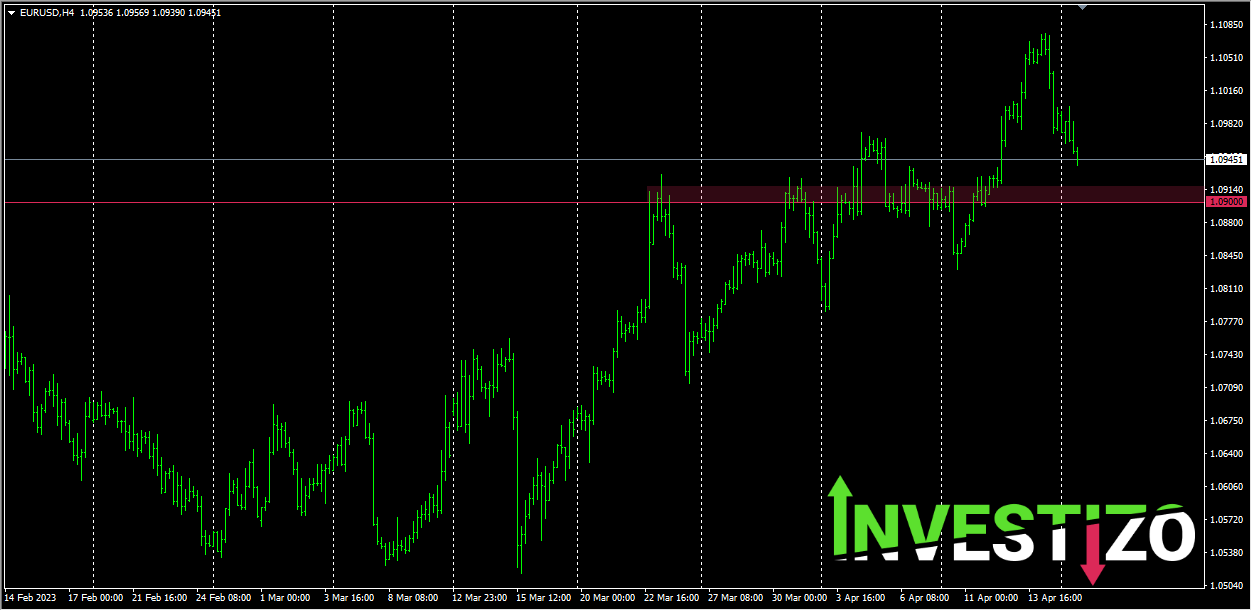
Last week, the EUR/USD currency pair reached a yearly high at the level of 1.1075. Currently, the chart shows a corrective movement downwards. The nearest significant support is above the level of 1.0900. If the fundamental factors continue to support the pair, it may resume its growth with promising targets at levels of 1.12-1.14. Otherwise, the currency pair may continue its corrective decline towards the level of 1.08.
Fundamental analysis
Market participants expect the European Central Bank to continue tightening its monetary policy, which creates a local bias for the European currency over the dollar. Against this background, it is worth paying attention to the inflation data in the EU, which will be published on Wednesday, as it may affect the market's further expectations.
GBP/USD
Technical analysis
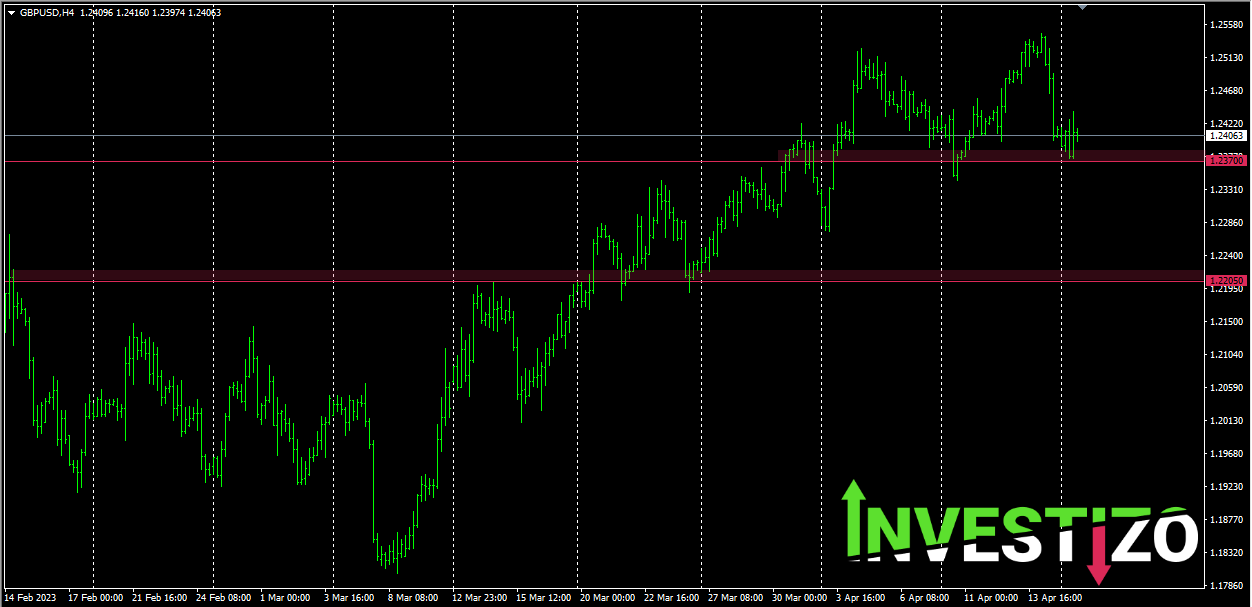
Last week, the exchange rate of the British currency against the US dollar remained virtually unchanged. The currency pair continues to trade in a limited range, but so far, it is held above the intermediate support level of 1.2370. Therefore, the overall sentiment on the instrument remains bullish. If buyers cannot hold the price above the level of 1.2370, the currency pair may demonstrate a decline towards the area of 1.2205 in the medium term.
Fundamental analysis
Like other world currencies, the British pound was able to strengthen against the US dollar in the first half of last week. Investors bet on the early completion of the tightening cycle of the US monetary policy against the backdrop of further rate hikes in the UK. However, the currency pair could not hold at the achieved levels and returned to the opening positions of the trading week on Friday amid the recovery of the dollar index. In the coming week, it is worth paying attention to the data on the unemployment rate for February, inflation, and retail sales for March, and preliminary data on the business activity index in the services sector from S&P Global/CIPS. This block of macroeconomic statistics from the UK may change the balance of power in the market.
Gold
Technical analysis
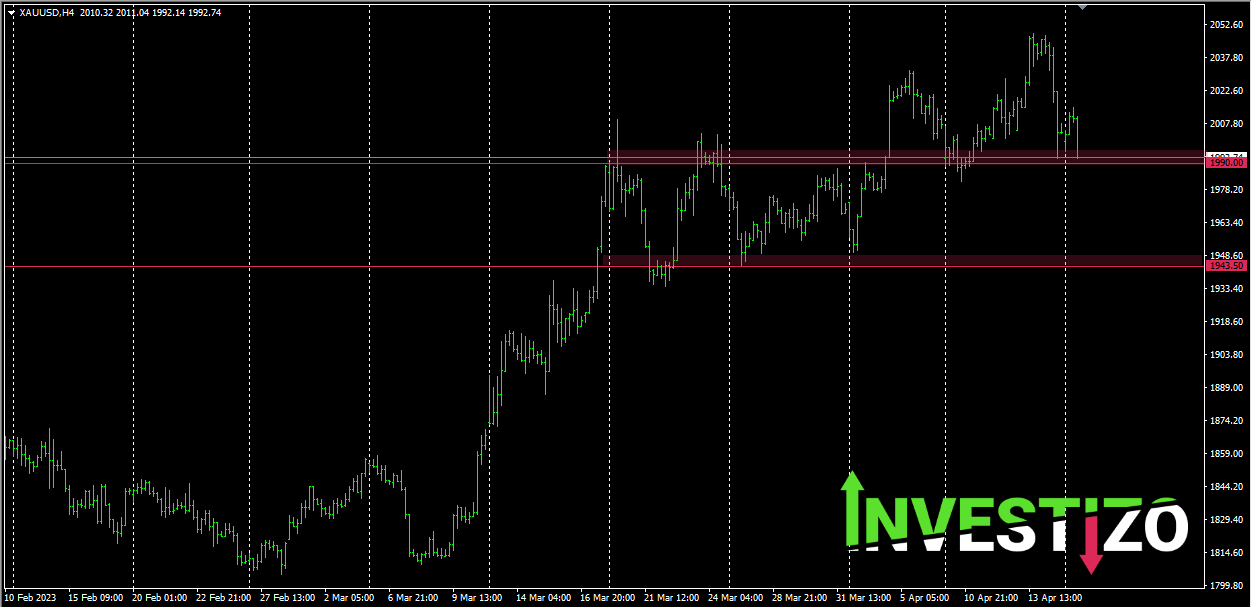
After updating the local maximum, the price of gold headed downwards. On Monday, the corrective movement continues, but buyers manage to keep the price above 1990.00, so the bullish sentiment remains on the chart. If the level of 1990.00 is broken, the price may continue to decline towards the level of 1943.50.
Fundamental analysis
The fundamental background for gold remains positive. Geopolitical and economic risks, high inflation, and soft monetary policy continue to support the demand for the precious metal. However, the upward momentum may be limited by the expected rate hikes from major central banks and the possible easing of global trade tensions.