
Fundamental analysis of USD/JPY
The currency pair USD/JPY fluctuated around the average level of 144.500 without significant growth. The movement of the currency pair can be characterized as a bullish consolidation due to the recovery from the June lows.
One of the important factors affecting the pair USD/JPY is the difference in monetary policy between the Bank of Japan (BoJ) and the Federal Reserve (Fed). The BoJ has pledged to maintain a very loose monetary policy. The central bank's main objective is to ensure substantial wage increases in order to keep price growth on target. Bank of Japan Governor Kazuo Ueda stressed the importance of continuing the soft monetary policy until at least next year to support Japan's fragile economic recovery.
Complicating matters is data from Japan's service sector, which showed slower-than-expected growth in June, with the PMI dropping to 54.0 from 55.9. Although demand remains strong and firms report stronger inflationary pressures, output price inflation has weakened. China's service sector is repeating the same pattern.
The Fed, on the other hand, seems to be taking a different approach. Fed Chairman Jerome Powell said two more rate hikes are likely this year. Markets also anticipate a 25 basis point rate hike at the next FOMC meeting on July 25-26. This expected policy tightening should support higher U.S. Treasury yields, which in turn would be good for the U.S. dollar. However, recent weak economic data, such as the U.S. PCE Price Index and weak ISM PMI, raised concerns about the Fed's ability to maintain policy tightening.
The US economic calendar remains relatively loose for now, but after a disappointing manufacturing PMI from ISM, the focus will be on US factory orders. An unexpected drop in factory orders could weaken the market's appetite for the dollar.
Investors' attention is especially riveted to the release of the minutes of the June FOMC meeting, which will give us an idea of the Fed's future approach to rate hikes, which will be very important. This is one of the major factors affecting the strength of the dollar. Market participants will also be closely watching the ISM non-manufacturing PMI and the U.S. jobs report. This is because they may affect sentiment on further rate hikes.
Thus, the USD/JPY pair remains sensitive to the opposite monetary policies of the Bank of Japan and the Federal Reserve System, as well as to changes in economic indicators. In the short term the uncertainty about the US economic data and the policy of the Bank of Japan may slow down the significant growth of the currency pair, however the expectations of the FRS rate increase provide support for the USD.
Technical analysis and scenarios:
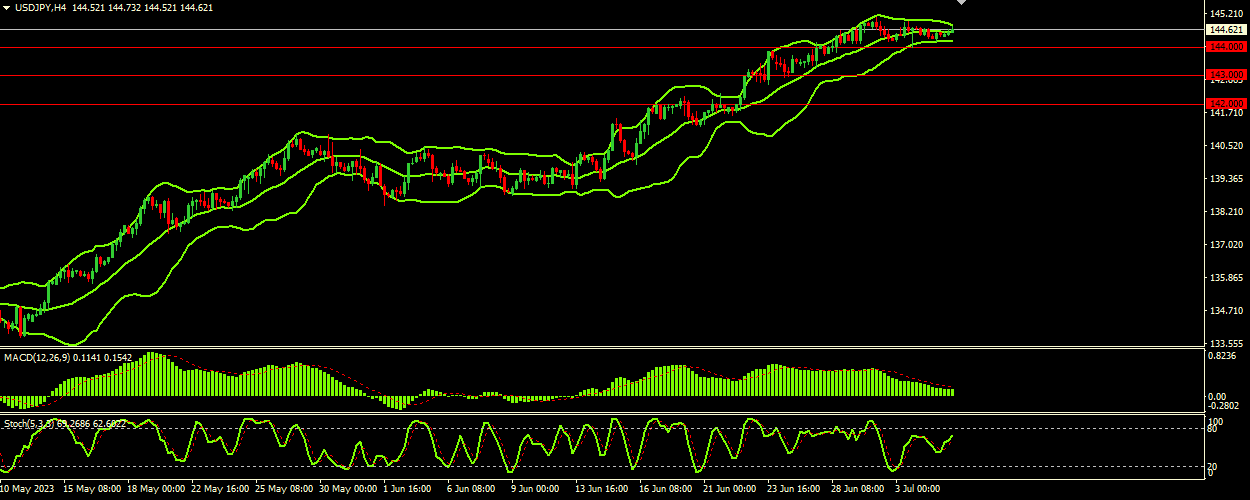
Technical indicators show that the pair is currently in the upper Bollinger Band range, indicating bullish pressure.
Main scenario (BUY).
Recommended entry level: 145.000.
Take Profit: 146.000.
Stop loss: 144.500.
Alternative scenario (SELL)
Recommended entry level: 144.000.
Take profit: 143.000.
Stop loss: 144.500.